




“The governance of eThekwini Metropolitan Municipality is facing renewed scrutiny over reported water losses, rising municipal debt and continuing infrastructure challenges, with the latest reporting indicating that non-revenue water reached about 65% in June 2026. The developments have intensified debate about municipal accountability, financial management, infrastructure maintenance and the ability of local government to provide reliable basic services ahead of South Africa’s 4 November 2026 local government elections.”
The state of governance at eThekwini Metropolitan Municipality has come under renewed public and political scrutiny following reports of substantial water losses, rapidly increasing municipal debt and continuing infrastructure pressures. The municipality, which includes Durban and surrounding communities in KwaZulu-Natal, is one of South Africa’s eight metropolitan municipalities and serves a population of about 4.2 million people, according to the 2022 national census.
The latest concerns place basic service delivery at the centre of the governance debate. According to reporting published this week, eThekwini was estimated to be losing approximately 21 billion litres of water every month by June 2026. That represented about 65% of the municipality’s water, compared with 48.9% in 2021. More than 13,000 active leaks were also reported to remain outstanding during the period.
Water losses on this scale have implications beyond the technical operation of a municipal water network. They affect municipal finances, household access to water, infrastructure planning and public confidence in local government. The financial implications are also significant. Reporting indicates that the cost associated with water losses reached approximately R2.9 billion during the 2024/25 financial year, while spending on water tankers increased substantially over a five-year period.
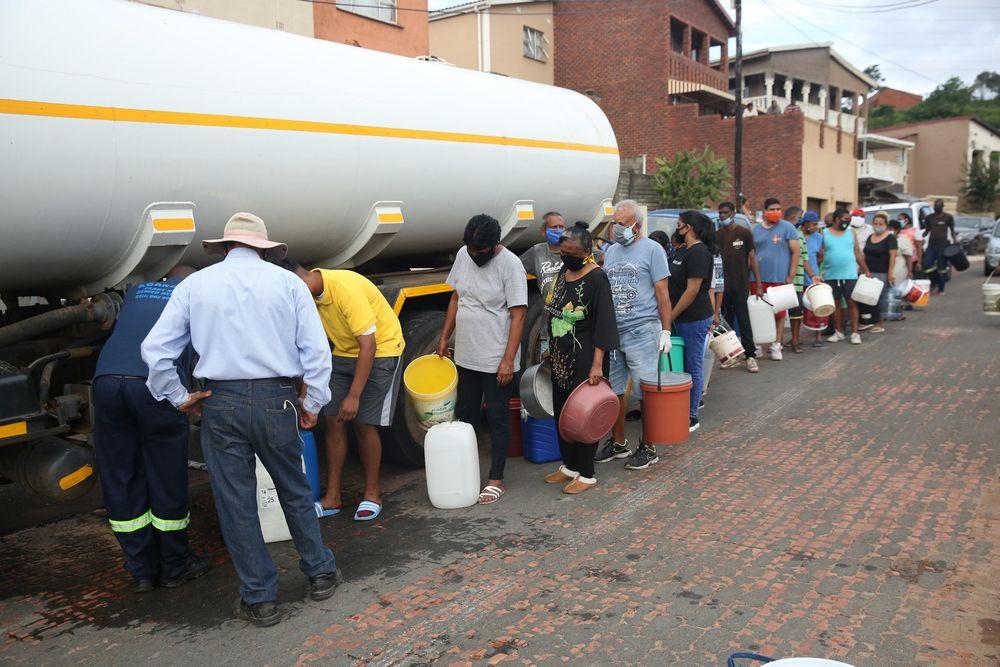
The municipality has responded by expanding its own capacity to provide emergency water supplies. In a development reported on 1 October, eThekwini announced that it had ended the outsourcing of water tanker services after investing approximately R345 million in its own tanker fleet. The municipality said it had 318 operational tankers, with another 43 expected before the end of the year. The stated purpose is to strengthen the city’s ability to respond to water shortages and reduce response times.
The move illustrates the difficult choices facing local government when infrastructure problems persist. Tankers can provide an important emergency service when communities experience interruptions, but they do not replace functioning pipelines, reservoirs, treatment facilities, meters and leak-repair systems. Consequently, the longer-term governance question is how effectively municipal resources are being directed toward preventing losses while maintaining emergency support for residents.
The financial position of the municipality adds another dimension to the issue. According to recent reporting, eThekwini’s municipal debtors increased from approximately R15.9 billion in 2021 to around R49 billion. A separate statement issued by the Democratic Alliance cited July 2026 uncollected debt of R48.679 billion, describing it as equivalent to 64.6% of the municipality’s annual budget of R75.3 billion. Because the latter figures come from a political party, they should be understood as a party statement rather than an independent assessment.
The broader financial governance picture is also important. The DA statement cited approximately R4.54 billion in irregular, fruitless and wasteful expenditure for the 2024/25 financial year, while Newsday reported irregular expenditure of R4.48 billion. These figures underline why municipal financial controls, procurement procedures and consequence management are central issues in discussions about governance.
Independent findings from the Auditor-General of South Africa provide wider national context. In its 2024/25 local-government assessment, the Auditor-General reported that 177 municipalities, or 69%, incurred unauthorised expenditure totalling R36.05 billion during the financial year. The Auditor-General also reported that municipalities collectively recorded significant water and electricity distribution losses and that none of South Africa’s metropolitan municipalities achieved a clean audit in the 2024/25 cycle.
The Auditor-General has separately highlighted concerns relating specifically to eThekwini. Its 2025/26 institutional reporting says data analytics identified discrepancies in water-tanker invoicing at the municipality, including a case involving a vehicle that was recorded as delivering a large volume of water despite the type of vehicle identified. The matter was progressed as a material irregularity. This does not by itself establish wrongdoing by every person or contractor involved, but it demonstrates why procurement, verification and oversight systems matter when municipalities spend large amounts on emergency services.
Governance challenges at eThekwini therefore extend beyond the question of whether water is reaching households. They involve the complete chain of municipal administration: planning, budgeting, procurement, infrastructure maintenance, revenue collection, billing, management performance and political oversight.
The issue has also become politically significant because South Africa is approaching the 2026 local government elections. The elections are scheduled for 4 November, putting municipal performance under greater public attention. The timing means that competing political parties are presenting different explanations for service-delivery problems and different proposals for improving municipal administration.
For example, the Democratic Alliance has questioned the approval of high performance scores for senior eThekwini managers. The party said the council approved scores ranging from 3.83 to 4.23 out of five for senior officials and argued that these assessments were difficult to reconcile with the municipality’s service-delivery difficulties. These are the DA’s political claims and should be distinguished from independently established findings.
The municipality’s own actions nevertheless demonstrate that officials recognise the seriousness of the water challenge. Bringing tanker operations in-house represents an attempt to build direct municipal capacity. The city says its expanded fleet should improve its ability to respond to communities experiencing water shortages.
The longer-term challenge will be preventing emergency measures from becoming a permanent substitute for infrastructure renewal. A sustainable municipal water system requires accurate metering, effective billing, rapid leak detection, maintenance programmes, capital investment and reliable procurement. It also requires residents and businesses to pay legitimate bills while the municipality ensures that billing systems are accurate and that collected revenue is used effectively.
The eThekwini situation also illustrates why governance cannot be measured solely through political leadership or election results. Administrative competence, financial controls and institutional capacity can have immediate consequences for residents. When water is lost before reaching consumers, municipal revenue can decline while emergency expenditure increases. When debtors grow, the municipality can face greater pressure on its cash flow. When infrastructure deteriorates, the eventual cost of rehabilitation can become considerably larger.
At the same time, accountability requires examining evidence carefully. Political parties have an important role in challenging municipal administrations, but allegations and campaign claims should be distinguished from findings by institutions such as the Auditor-General and formal municipal records. This distinction is particularly important during an election period when governance performance becomes a central political issue.
The central question for eThekwini is therefore how the municipality can convert emergency responses into lasting improvements in infrastructure and administration. Reducing water losses, strengthening revenue collection, improving procurement controls and ensuring effective consequence management are interconnected tasks rather than isolated policy problems.
The municipality’s reported 65% water loss rate, rising debt and infrastructure pressures have consequently placed governance firmly at the centre of public discussion. Independent audit findings show that eThekwini’s challenges occur within a wider national local-government environment in which municipalities continue to face financial and service-delivery pressures.
As residents prepare to participate in the November local government elections, the eThekwini debate is likely to remain focused on measurable questions: how much water reaches consumers, how much is lost, how effectively municipal revenue is collected, how public money is spent and whether infrastructure projects deliver their intended results. Those indicators provide concrete ways to assess municipal administration and accountability beyond campaign rhetoric.



