




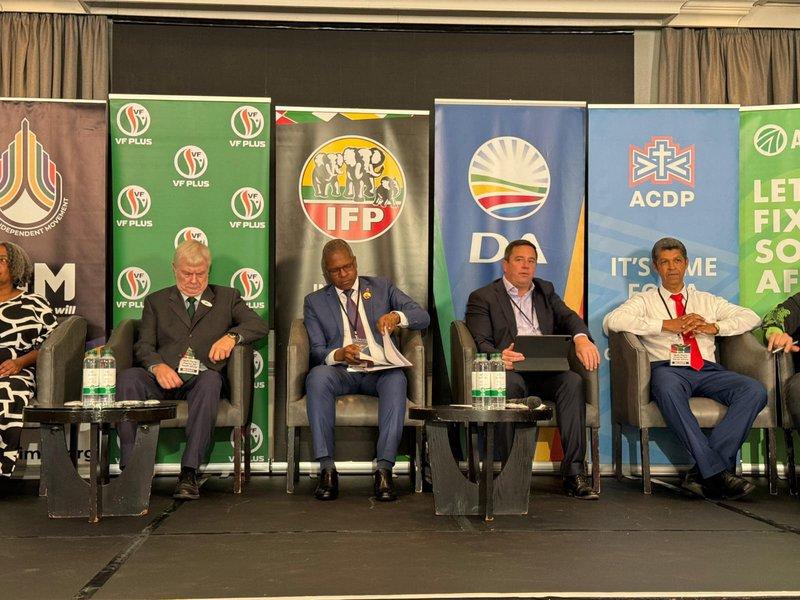
“Political leaders from the ANC, DA, EFF, IFP and ActionSA clashed at a Johannesburg election debate over coalition governance, service delivery, corruption, immigration, housing and the future management of the city. The debate comes ahead of South Africa’s 4 November 2026 local government elections, with Johannesburg emerging as a major focus of the campaign.”
Johannesburg Election Debate Puts Coalition Governance and Service Delivery at Centre of 2026 Local Poll
Johannesburg — Political leaders from the ANC, DA, EFF, IFP and ActionSA confronted one another at a Johannesburg election debate on Thursday, with service delivery, coalition government, corruption, immigration, housing and economic opportunity dominating the discussion. The event, held at Wits University and hosted by Arena Holdings in partnership with the university, came just over a month before South Africans vote in the 4 November 2026 local government elections.
Johannesburg is particularly significant because of its economic scale and political importance. TimesLIVE reported that the city contributes between 15% and 16.5% of South Africa’s national gross domestic product, while the contest for control of the municipality is taking place after years of coalition changes and disputes over governance. The Electoral Commission has scheduled the local government elections for 4 November, and the day has been declared a public holiday.
Coalition government became one of the central themes of the debate. Johannesburg has experienced changing political alliances and administrations, making questions about stability, accountability and cooperation especially important in the current campaign. The parties differed sharply over whether a single-party administration or another coalition arrangement would provide a more workable governing structure. That tension is likely to remain central as parties campaign across the city during October.
DA leader Geordin Hill-Lewis argued that his party would seek an outright majority in Johannesburg. He linked the proposal to what he described as the need for a stable administration and said the city required stronger professional management. He also criticised political deployment in municipal administration and argued that senior officials should be selected for their qualifications and ability to manage the city’s large workforce.
The EFF challenged the DA’s description of coalition government involving the EFF as chaotic. EFF leader Julius Malema rejected allegations raised during the debate concerning tenders and the party’s conduct in municipalities. The discussion became particularly contentious when Hill-Lewis referred to the VBS Mutual Bank controversy and parliamentary findings involving former EFF deputy president Floyd Shivambu. Malema disputed the implications drawn from those matters and argued that political disagreements should not automatically be presented as evidence of financial misconduct by EFF municipal representatives.
ANC deputy secretary-general Nomvula Mokonyane defended the ANC’s renewal agenda while acknowledging shortcomings in its previous governance of Johannesburg. She said the city had been filling strategic vacancies, including positions for engineers and other technical specialists, and that the ANC wanted stronger cooperation with national government departments to improve revenue management.
Mokonyane also outlined proposals involving municipal finances and service delivery. She said the ANC wanted revenue from water and electricity services to be ring-fenced so that funds could be directed to the entities responsible for those services. She also referred to strengthening Pikitup, reviving the Jozi@Work programme and restoring an indigent policy.
Revenue collection itself became a point of disagreement. Mokonyane said collection had risen above 90%. However, Johannesburg’s 2026/27 budget documents, cited by TimesLIVE, show a revised collection rate of 86%, compared with 88.6% previously. The city identifies illegal connections, billing problems and revenue leakages among the continuing challenges affecting municipal finances.
Housing and spatial inequality also featured in the discussion. Mokonyane questioned the DA’s approach to public land and housing access, particularly for disadvantaged communities. Hill-Lewis responded by pointing to national human settlements figures that, according to him, showed Cape Town had delivered more state-subsidised housing than any other metropolitan municipality over the previous five years.
Immigration was another major point of disagreement. Malema argued against political mobilisation based on ethnicity or race and rejected the idea that ordinary residents should take responsibility for determining whether people are legally present in South Africa. He also opposed xenophobic vigilantism.
IFP leader Velenkosini Hlabisa agreed that ethnic mobilisation could be dangerous but maintained that his party opposed the continued presence of undocumented foreign nationals. ActionSA leader Herman Mashaba likewise identified illegal immigration as one of Johannesburg’s major challenges, while stressing that his political identity should not be reduced to that issue.
Mashaba also drew on his previous experience as Johannesburg mayor from 2016 to 2019. He criticised the DA’s conduct during that period and alleged that he had dismissed three DA members of the mayoral committee over corruption allegations while the party later declined to remove them as councillors. The DA disputed the broader political narrative surrounding Mashaba’s administration.
Economic conditions formed another part of the debate. Hill-Lewis defended the national government of national unity and argued that economic reforms were beginning to improve conditions. Malema disagreed, pointing to weak economic growth and arguing that the GNU should not automatically be treated as evidence of economic success.
The discussion also placed pressure on parties to explain how proposed changes would be financed, implemented and measured, rather than relying only on campaign promises or broad descriptions of improvement for residents across Johannesburg.
The election context also includes a large field of candidates. The IEC announced in September that 136,790 candidates had met the statutory requirements to contest the 2026 local government elections nationally. Of these, 98,219 were nominated by parties for ward contests, 38,571 were nominated by parties for proportional representation contests and 621 were independent ward candidates.
The election is also unfolding alongside legal disputes over candidate lists. The IEC has opposed a Democratic Alliance challenge involving four parties that submitted a single name in candidate lists, warning that the requested relief could disrupt the election timetable. Separately, the ANC is pursuing a Constitutional Court case concerning 181 councillor candidates excluded after the party did not complete the final submission process on the IEC’s online portal before the deadline.
These disputes underscore the administrative importance of election rules as campaigning intensifies. Candidate eligibility, ballot preparation, deadlines and legal challenges can affect which choices appear before voters and how the election process proceeds.
The Johannesburg debate also highlighted the practical question of what happens after voting. If no party secures an outright majority, parties may need to negotiate working arrangements in council. Such arrangements can involve policy agreements, committee responsibilities and the selection of municipal leadership. The participants differed over the advantages and risks of coalition government, but the debate showed that coalition politics is likely to remain relevant to Johannesburg’s governance.
For residents, the most immediate issues remain practical: water availability, electricity, waste collection, housing, roads, public spaces, safety and employment opportunities. Political parties are offering different explanations for the city’s problems and different proposals for addressing them. The debate gives voters an opportunity to examine those claims alongside municipal records, budgets, election manifestos and the responsibilities assigned to local government.
As the 4 November election approaches, Johannesburg is therefore emerging as a major focus of South Africa’s 2026 local political contest. The Wits debate brought competing approaches to governance into direct confrontation, while also exposing areas of agreement, including the need to improve municipal performance and address residents’ concerns.
The final outcome will be determined by voters on election day. Until then, the debate provides a snapshot of the competing policy positions, records and arguments being placed before Johannesburg residents. The central questions are clear: how should the city be governed, how can coalitions or majorities provide accountability, how should scarce municipal resources be managed, and what practical steps can improve services for residents?



