




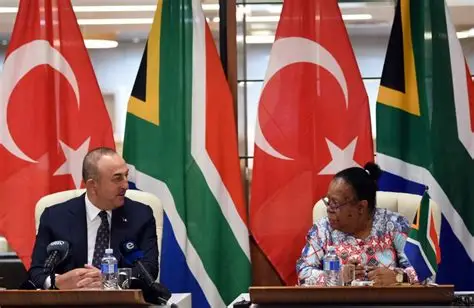
“President Cyril Ramaphosa has defended South Africa’s non-aligned foreign policy, stressing that the country seeks constructive engagement with both Western and Eastern powers despite tensions with the United States. He emphasized that South Africa’s approach is rooted in constitutional principles, human rights, and multilateral cooperation.”
South Africa’s foreign policy has once again come under scrutiny as President Cyril Ramaphosa defended the country’s non-aligned stance in the face of mounting tensions with the United States. Speaking during a National Council of Provinces (NCOP) session, Ramaphosa outlined the principles guiding South Africa’s international relations, emphasizing sovereignty, equality, and dialogue. His remarks come at a time when Washington has expressed concern over Pretoria’s engagements with China, Russia, and Iran, raising questions about South Africa’s global positioning.
Background of the Tensions
The latest diplomatic friction stems from comments made by US Ambassador Leo Brent Bozell III, who criticized South Africa’s foreign policy on social media, particularly its deepening ties with Beijing and Tehran. Deputy President Paul Mashatile’s recent visit to China further fueled speculation about Pretoria’s strategic leanings. The United States, already wary of South Africa’s participation in joint military exercises with Russia and China, has raised concerns about whether Pretoria’s stance undermines Western interests in Africa.
Ramaphosa’s Defense
Ramaphosa was unequivocal in his defense, stating: “We don’t see ourselves as a country of enemies. We are a country that seeks to be at peace with all other countries and have good relations with all.” He stressed that non-alignment does not equate to neutrality or disengagement but rather reflects an independent foreign policy aimed at fostering dialogue and cooperation. According to Ramaphosa, South Africa’s approach allows it to engage constructively with diverse powers, including the US, China, Russia, and Iran, without compromising its sovereignty.
Principles of South Africa’s Foreign Policy
Ramaphosa reiterated that South Africa’s foreign policy is grounded in the Constitution and guided by principles of human rights, peace, and multilateralism. The government seeks to promote a rules-based international order, ensuring that engagements are based on mutual respect and non-interference. This framework, he argued, enables South Africa to pursue national interests while contributing to global stability.
Relations with the United States
Despite tensions, Ramaphosa emphasized the importance of South Africa’s long-standing relationship with the United States. He highlighted areas of cooperation such as trade, investment, health, education, and security. The president acknowledged differences but insisted that engagement, even in disagreement, is essential. “Non-engagement does not serve any of us any good,” he remarked, underscoring Pretoria’s commitment to dialogue.
Strategic Autonomy and Global Engagement
South Africa’s non-aligned stance reflects a broader strategy of strategic autonomy. By maintaining flexibility in its foreign relations, Pretoria seeks to maximize opportunities for trade, investment, and security cooperation across multiple regions. This approach also positions South Africa as a mediator in global disputes, leveraging its credibility as a country that does not align exclusively with any bloc.
Military Exercises and Security Cooperation
Ramaphosa defended South Africa’s participation in joint military exercises with countries such as the US, China, and India, noting that these engagements are routine and consistent with non-alignment. Such exercises, he explained, provide opportunities to share experiences, enhance capabilities, and strengthen peacekeeping operations. Critics, however, argue that joint drills with Russia and China risk signaling a tilt away from Western alliances.
Implications for International Relations
South Africa’s stance has significant implications for its role in global politics. By asserting its independence, Pretoria challenges the notion that African states must align with either Western or Eastern powers. This positioning enhances South Africa’s influence within multilateral platforms such as the African Union, BRICS, and the United Nations, where it advocates for dialogue and equitable global governance.
Domestic Reactions
Within South Africa, reactions to Ramaphosa’s defense have been mixed. Supporters applaud the government’s commitment to sovereignty and independence, while critics warn that tensions with the US could jeopardize trade relations, particularly under the African Growth and Opportunity Act (AGOA). Business leaders have urged the government to balance its engagements carefully to avoid economic fallout.
Conclusion
President Ramaphosa’s reaffirmation of South Africa’s non-aligned foreign policy underscores the country’s determination to chart its own course in international relations. While tensions with the United States highlight the challenges of this approach, Pretoria remains committed to dialogue, cooperation, and multilateralism. As global power dynamics evolve, South Africa’s strategic autonomy may prove to be both a strength and a source of contention in its international engagements.



