




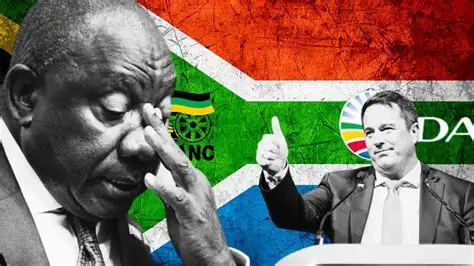
“The ANC fell below 50% in the July 2026 elections, ending its three-decade dominance and compelling it to share power with the DA in a Government of National Unity. This coalition represents a generational shift toward citizen-centered governance, reshaping accountability and transparency in South Africa.”
The ANC fell below 50% in the July 2026 elections, ending its three-decade dominance and compelling it to share power with the DA in a Government of National Unity. This coalition represents a generational shift toward citizen-centered governance, reshaping accountability and transparency in South Africa.
South Africa has entered a new political era. For the first time since Nelson Mandela’s presidency, the African National Congress (ANC) has lost its majority in Parliament, securing less than 50% of the vote in the July 2026 national elections. This seismic outcome has compelled the ANC to form a Government of National Unity (GNU) with the Democratic Alliance (DA), fundamentally altering the country’s political landscape.
Historical Context
Since 1994, the ANC dominated South African politics, winning every election with a majority. This dominance gave the party near-total control over state institutions, procurement, and resource distribution. However, decades of corruption scandals, service delivery failures, and economic stagnation steadily eroded public trust. Scandals such as state capture, mismanagement of Eskom, and failures in healthcare delivery became emblematic of governance decay. By 2026, voters demanded accountability and alternatives, paving the way for the DA’s rise.
Election Results
The Independent Electoral Commission (IEC) confirmed that the ANC fell short of majority rule. The DA emerged as the second-largest party, buoyed by urban middle-class support and disillusioned ANC voters. Smaller parties, including the Economic Freedom Fighters (EFF) and regional movements, gained modest support but now hold critical leverage in coalition negotiations. The GNU was formed to prevent political paralysis and to block what the DA described as “destructive populist forces” from capturing state power.
The DA’s Role
DA leader Geordin Hill-Lewis framed the coalition as both a defensive and proactive move. On one hand, it prevents instability by sidelining radical populist movements. On the other, it allows the DA to showcase its governance capacity. Hill-Lewis emphasized that the state “does not belong to the ANC, nor to any single party—it belongs to citizens.” This rhetoric signals a deliberate shift toward citizen-centered governance.
Implications for Governance
The GNU introduces a new dynamic in decision-making. Unlike the ANC’s unilateral control, coalition politics require negotiation across party lines. This could slow down policy implementation but also foster accountability. The DA has pledged to maintain transparency and to publicly challenge the ANC when it resists compromise or prioritizes party survival over citizen welfare.
Public Reaction
South Africans have responded with a mix of optimism and skepticism. Many citizens welcome the end of ANC dominance, hoping it will usher in greater accountability and improved service delivery. Others worry that coalition politics may lead to gridlock, with parties prioritizing their own interests over national progress.
International Perspective
Globally, South Africa’s political shift has been closely watched. Analysts argue that the GNU could strengthen democratic institutions by reducing one-party dominance. However, they caution that coalition governments often face challenges in maintaining unity, especially when ideological differences are stark.
Challenges Ahead
The GNU must address pressing issues:
- Economic stagnation: South Africa’s economy has struggled with low growth and high unemployment.
- Energy crisis: Eskom’s failures continue to undermine productivity and public trust.
- Corruption: Decades of scandals have eroded confidence in government institutions.
- Service delivery: Healthcare, education, and housing remain inadequate for millions of citizens.
Conclusion
The ANC’s loss of majority power marks a turning point in South African politics. The GNU with the DA represents both an opportunity and a challenge: an opportunity to rebuild trust and strengthen democracy, and a challenge to maintain unity and deliver tangible improvements in citizens’ lives. The coming months will determine whether this coalition can rise above partisan interests and truly serve the people.



