




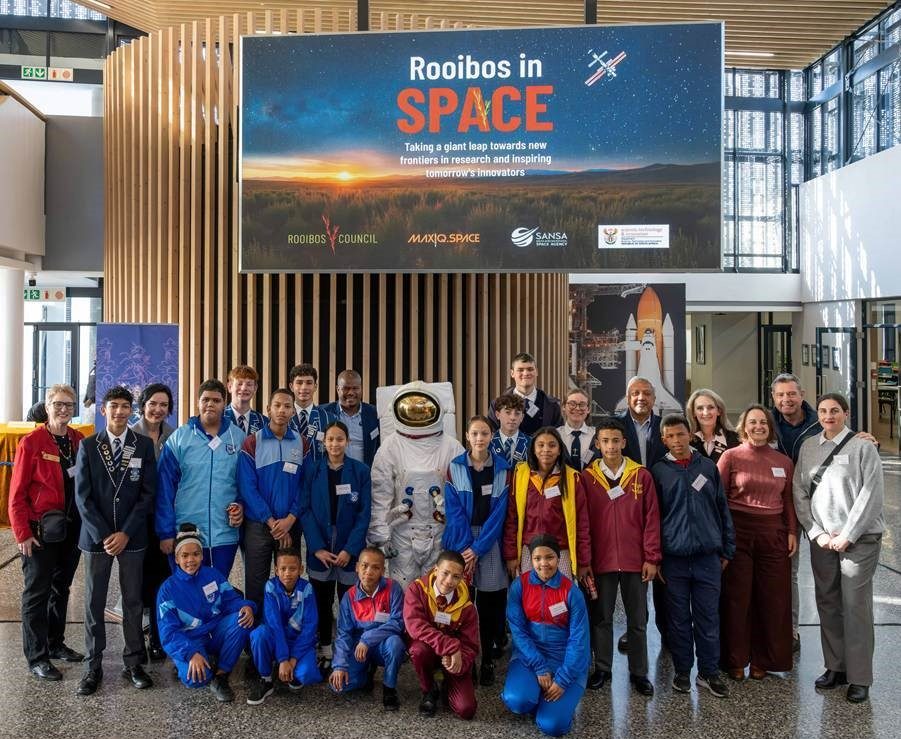
“South Africa has unveiled the Rooibos in Space programme, sending rooibos seeds to the ISS in October 2026 to test their germination and resilience under microgravity and cosmic radiation. The initiative, led by SANSA, MaxIQ Space, and the South African Rooibos Council, also engages learners from the Cederberg region in hands-on STEM research, linking agriculture, education, and space exploration.”
South Africa has taken a bold step into the frontier of space-based agriculture with the launch of the Rooibos in Space programme. This pioneering initiative, announced on July 17, 2026, at Parklands College’s Innovation Centre in Cape Town, represents the country’s first experiment in plant biology aboard the International Space Station (ISS). By sending rooibos seeds into orbit, scientists and educators aim to explore how microgravity and cosmic radiation affect plant growth, resilience, and yield, while simultaneously inspiring the next generation of learners through hands-on STEM education.
Background and Significance
Rooibos, a plant native to South Africa’s Cederberg region, is globally renowned for its health benefits and cultural importance. Its inclusion in space research is both symbolic and scientific. Symbolically, rooibos represents South Africa’s agricultural heritage and innovation. Scientifically, it offers unique genetic traits that may prove valuable in extraterrestrial agriculture. The experiment aligns with international efforts to develop sustainable agricultural systems for long-duration space missions, such as NASA’s Artemis programme, which envisions human settlements on the Moon and eventually Mars.
Scientific Goals
The experiment seeks to answer several key questions:
- How does microgravity affect rooibos seed germination rates?
- What impact does space radiation have on plant resilience and yield?
- Can rooibos contribute to future space-based food systems?
Seeds will spend six weeks in orbit inside a specialised Voyager Nanolab prepared by MaxIQ Space. Upon return, researchers will compare them with Earth-based control samples, beginning planting in February 2027. Learners will monitor the plants for 18 months, tracking growth through maturity and the first harvest.
Educational and Community Impact
The programme is not only a scientific experiment but also a major educational initiative. Learners from seven schools in the Cederberg region—the birthplace of rooibos—will participate in comparative studies. Seeds exposed to space conditions will be planted alongside control seeds on local farms, allowing students to collect and analyse data. Parklands College in Cape Town will run a parallel experiment, ensuring broader participation and comparative datasets. This hands-on involvement is expected to inspire interest in STEM careers, particularly in space science and agriculture.
Global Context
Recent years have seen a renewed global emphasis on plant research in space, driven by upcoming long-duration exploration missions. Experiments aboard the ISS have demonstrated that crops such as lettuce can grow in microgravity, while studies on peas and soybeans have provided insight into how plants respond to altered gravity and environmental stressors. These findings are contributing to advances in both future space-based food systems and agricultural resilience on Earth. Rooibos now joins this growing body of research, offering a uniquely South African contribution to the global scientific community.
Industry and Policy Implications
According to Dawie de Villiers, Director of the South African Rooibos Council (SARC), the project reflects the industry’s focus on innovation, education, and applied research. It also underscores the role of SANSA in advancing South Africa’s space economy, which is increasingly seen as a driver of technological development and international collaboration. The initiative highlights the intersection of agriculture, education, and space science, positioning South Africa as a contributor to global space research while promoting local industry and cultural heritage.
Conclusion
The Rooibos in Space programme is more than a scientific experiment; it is a national milestone that bridges agriculture, education, and space exploration. By sending rooibos seeds to the ISS, South Africa is not only contributing to global scientific knowledge but also inspiring its youth to imagine futures beyond Earth. As the seeds journey into orbit and return to be studied, they carry with them the hopes of a nation eager to innovate, educate, and explore.



