




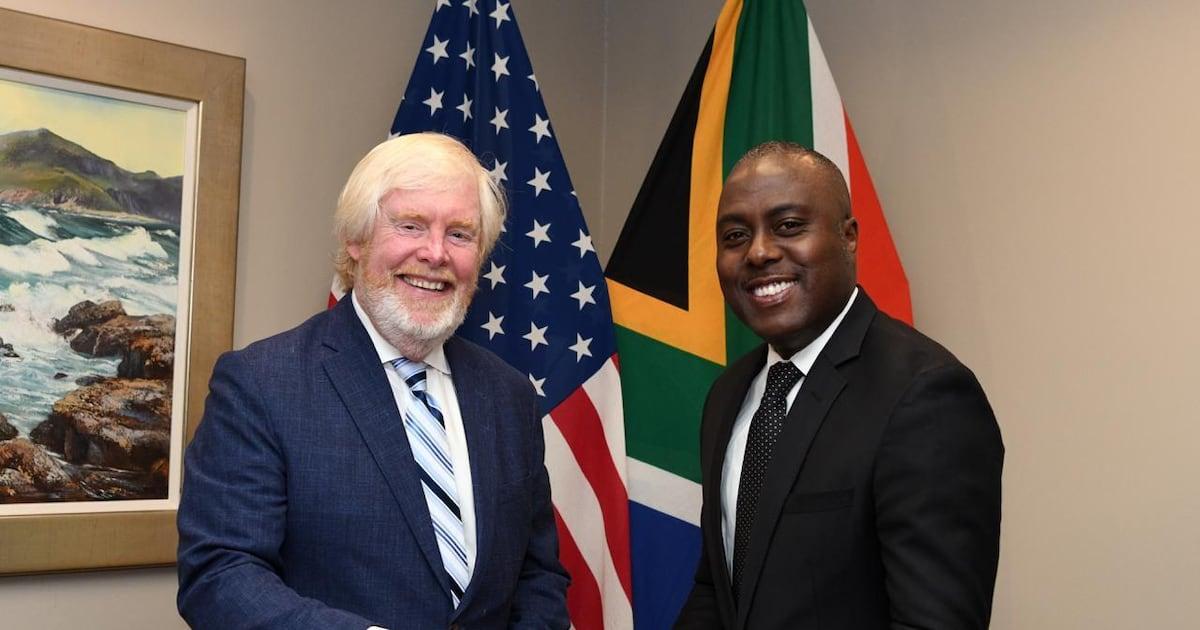
“South Africa–US relations have deteriorated further after International Relations Minister Ronald Lamola criticised US Ambassador Leo Brent Bozell, while Bozell accused the minister of personally insulting him. The latest confrontation follows South Africa’s third formal diplomatic protest against Bozell in nine months, although both sides continue to say that dialogue and cooperation remain possible.”
South Africa’s relationship with the United States has entered another difficult phase, with a public exchange between International Relations and Cooperation Minister Ronald Lamola and US Ambassador Leo Brent Bozell becoming the latest sign of deteriorating bilateral ties. The dispute follows South Africa’s third formal diplomatic protest against Bozell in nine months and has raised fresh questions about whether Pretoria and Washington can restore a relationship that remains important to both countries economically and strategically.
On Monday, 5 October 2026, several South African media outlets reported that Bozell had pushed back against Lamola’s criticism while insisting that Washington still wants to work with Pretoria. SABC News, EWN, eNCA and Jacaranda FM all identified the worsening relationship as a major development.
The immediate dispute centres on comments attributed to Lamola after Bozell said Washington had grown tired of discussions with Pretoria. Lamola argued that diplomacy requires continued dialogue and said that if the ambassador no longer wanted to engage, he should “get out of the kitchen”. Bozell subsequently accused Lamola of personally insulting him and argued that such rhetoric was contributing to the deterioration of relations.
EWN reported on Monday that Bozell nevertheless said the United States was not giving up on its partnership with South Africa. Speaking to Fox News, he said both sides needed to lower the temperature and find common ground. He also said Washington could help South Africa develop technology for mineral beneficiation and maintained that the two governments could overcome their differences. At the same time, he warned that further US measures could follow recent visa restrictions against unnamed South African citizens.
The contradictory messages reveal the central problem facing the relationship: both governments continue to describe bilateral cooperation as valuable, but they increasingly disagree over how that cooperation should be managed. Pretoria objects to what it sees as US interference in domestic affairs, while Washington says South Africa needs to respond to policy concerns that affect American investment and strategic interests.
SABC News reported that international relations expert Kingsley Makhubela viewed the latest dispute as evidence that tensions are escalating rather than being resolved. He argued that an ambassador’s basic function is to build relations between two countries and suggested that the repeated confrontations indicate that Bozell has struggled to reset the relationship.
Parliament’s Portfolio Committee on International Relations and Cooperation has indicated that it wants the Department of International Relations and Cooperation to explain the circumstances surrounding the latest démarche. EWN previously reported that the committee believes diplomats should respect the laws and regulations of the host country and avoid interfering in internal political affairs.
A démarche is a formal diplomatic protest. The fact that Bozell has faced three such protests in less than a year is politically significant because disagreements have repeatedly moved from private channels into public confrontation. Reuters reported that the latest summons was the third such action since Bozell began his duties, while the US State Department described his engagement with DIRCO as discussions on bilateral relations.
The disputes are rooted in several issues. Washington has criticised South Africa’s land and economic transformation policies, including the Expropriation Act and Broad-Based Black Economic Empowerment measures. US officials have also demanded stronger action on rural crime and have criticised the continued use of the “Kill the Boer” chant. According to eNCA, the United States has linked some of these concerns to visa restrictions affecting South Africans associated with race-based policies and land seizures.
Pretoria rejects the characterisation that its policies amount to racial discrimination and argues that transformation measures are designed to address inequalities created by apartheid. South African officials have also repeatedly defended the independence of the country’s courts and said foreign diplomats should not publicly challenge domestic judicial decisions. Parliament’s international relations committee has similarly argued that disagreements should be addressed through established diplomatic channels rather than media interviews.
The controversy over “Kill the Boer” illustrates the wider disagreement. South African courts have dealt with the chant within the country’s constitutional and historical framework, while US officials have continued to describe it as an unacceptable expression of hatred. The dispute therefore involves not only different political interpretations but also competing views about sovereignty, historical injustice and the limits of diplomatic commentary.
Jacaranda FM reported that tensions have also involved South Africa’s land reform policies, race-related measures and Pretoria’s foreign-policy positions. The United States has previously criticised South Africa over its approach to international issues, including its case against Israel at the International Court of Justice. These disagreements have added geopolitical dimensions to an already difficult bilateral relationship.
Despite these disagreements, the relationship remains too important in diplomatic terms for either side to ignore. Jacaranda FM noted that hundreds of US companies operate in South Africa and that tens of thousands of US citizens live in the country. Bozell has also highlighted potential cooperation in strategic minerals, technology and rural safety. These areas could provide opportunities for rebuilding trust.
Economic interests are especially important. South Africa needs foreign investment, technology, export opportunities and access to major markets. The United States also has strategic interests in Africa, including critical minerals, trade and security. A prolonged diplomatic dispute could make cooperation more difficult, particularly if political disagreements result in additional restrictions on travel, trade or investment.
For South Africa, the diplomatic challenge is to defend its sovereignty and domestic policy choices without allowing a disagreement with Washington to damage economic and strategic interests. At the same time, the government must decide how forcefully to respond when an accredited foreign ambassador publicly criticises domestic policies.
Washington faces a similar challenge. Public pressure can communicate US priorities, but repeated confrontations with South African officials may reduce the ambassador’s ability to act as an effective bridge between the two governments. SABC News reported an expert view that the ambassador’s central diplomatic mission is to build relations, making the repeated public disputes particularly concerning.
There are signs, however, that neither side wants a complete breakdown. Bozell said the United States was not abandoning engagement and described the current problems as obstacles that could still be overcome. South African officials have also repeatedly stated that they remain open to dialogue, even while rejecting what they consider attempts to dictate domestic policy.
The next stage will depend heavily on whether Pretoria and Washington can return disagreements to established diplomatic channels. Parliament’s planned engagement with DIRCO could clarify South Africa’s position, while further US statements or policy measures will test whether Washington is prepared to pursue negotiation rather than public confrontation.
Both countries have strong reasons to preserve cooperation even when they disagree. A durable reset will require Washington to respect South Africa’s sovereignty and constitutional institutions, while Pretoria continues engaging the United States on investment, security and bilateral trade.
The latest exchange between Lamola and Bozell may appear to be a dispute over words, but it reflects deeper disagreements about sovereignty, race, land, economic transformation, foreign policy and the role of diplomacy itself. If the two governments allow those disagreements to continue dominating their relationship, the costs could extend beyond politics into trade, investment and regional cooperation.
Bozell’s insistence that the United States still wants the partnership suggests that Washington sees value in maintaining ties. Pretoria’s continued emphasis on dialogue similarly indicates that South Africa is not seeking a permanent rupture.
For South Africa, the diplomatic test is to defend its national interests without closing doors to cooperation. For the United States, it is to pursue its interests without undermining the diplomatic relationship needed to achieve them. The coming weeks will show whether the war of words becomes temporary or signals a deeper restructuring of this important relationship.



