




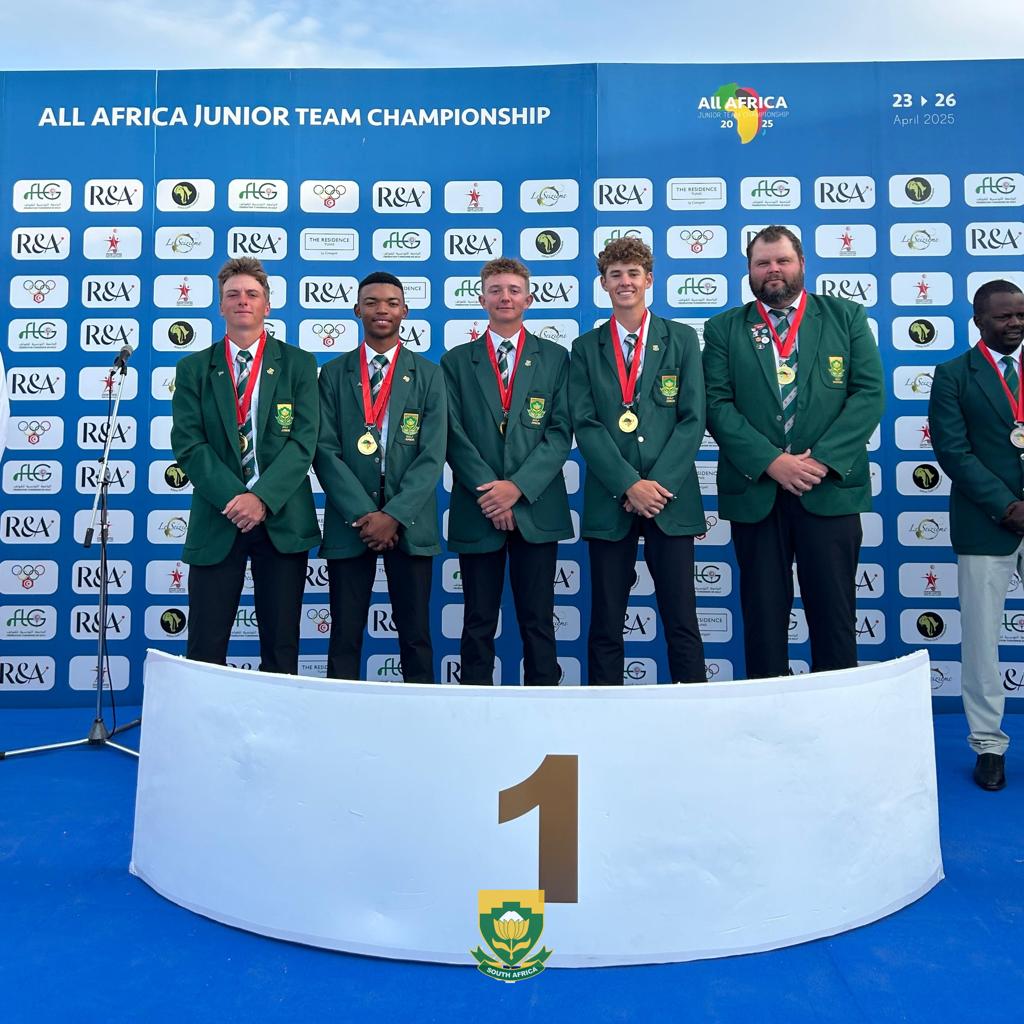
“South Africa won the 2026 All Africa Team Championship in Tunisia, finishing on 624 strokes, 24 under par, to defeat Morocco by four strokes and secure a record-extending 13th continental title. The comeback highlighted the strength of the country’s amateur golf system, with the team recovering from an eight-stroke overnight deficit to claim victory.”
South Africa Stages Stunning Comeback to Win Historic 13th All Africa Team Golf Championship
A continental triumph built on teamwork, consistency and pressure performance
South Africa’s amateur golfers have delivered a memorable continental performance, winning the 2026 All Africa Team Championship in Tunisia after overcoming an eight-stroke deficit to defeat Morocco by four shots. The victory, secured on Saturday, 17 October, extended South Africa’s record to 13 championship titles and reinforced the country’s reputation as one of Africa’s leading golf nations.
The tournament, played at the Golf Citrus La Forêt Course in Hammamet, brought together representatives from across the continent. For South Africa, the championship became a test of resilience, individual skill and collective determination. Although the team started behind its principal rivals, a powerful final round turned the competition around and delivered another significant achievement for the country’s amateur golf programme.
A challenging start against Morocco
South Africa entered the championship as defending champions after winning the title in Bulawayo, Zimbabwe, in 2024. Expectations were therefore high, but the opening round demonstrated that retaining the trophy would require patience and substantial improvement.
South Africa recorded a combined score of 214 in the first round, finishing two under par as a team. That performance placed the side fourth on the leaderboard, leaving it behind a fast-starting Moroccan team.
Morocco produced an impressive opening round of 205, finishing 11 under par. Mohamed Bouhamou led the charge with a 66, establishing himself as an early contender for the individual title and helping his country build a substantial advantage.
The difference between the teams highlighted the challenge facing the South Africans. An eight-stroke deficit after two rounds would require excellent scoring, careful decision-making and an ability to remain composed under pressure.
Rather than allowing the difficult opening position to undermine their confidence, the South Africans responded with a determined second-round effort.
South Africa begins closing the gap
The second round proved important in changing the direction of the championship. South Africa returned a combined score of 208, improving its position and moving into second place behind Morocco.
Ivan Verster contributed a four-under-par 68, while CJ van Wyk and Jonathan Wilsenach each returned rounds of 70. Their performances helped the team reduce the distance separating it from the leaders.
Nevertheless, Morocco maintained its advantage. The Moroccan team stood at 414 after two rounds, compared with South Africa’s 422. With eight strokes still separating the two countries, the championship remained firmly in Morocco’s hands going into the final day.
For the South Africans, the challenge was clear: they needed an exceptional final round without relying on mistakes from their opponents. Every birdie, recovery shot and successful putt could influence the outcome.
Team golf introduces an additional layer of responsibility because individual performances contribute to a shared result. Players must concentrate on their own games while understanding how their scores affect the team’s overall position.
South Africa’s second-round improvement kept the title within reach. More importantly, it provided the momentum needed for an extraordinary finish.
Two outstanding 66s transform the contest
South Africa delivered its decisive performance in the final round, recording a combined 202, equivalent to 14 under par. That was the lowest team total among the leading contenders on the closing day and proved instrumental in securing the championship.
Judd Sundelson and Wilsenach both produced six-under-par rounds of 66. Their outstanding performances provided the foundation for the comeback, while van Wyk added a valuable 70 to complete the team’s three counting scores.
Verster returned a 74, but under the championship’s scoring system, his score could be discarded because only the three best individual scores from each four-player team counted towards the daily total.
The format rewarded teams capable of producing several strong rounds simultaneously. South Africa’s three counting scores combined for 202, allowing the team to take advantage of its improved performance and establish a decisive lead in the final standings.
Morocco, meanwhile, recorded a combined 214 in the last round. Bouhamou, who had inspired the team during the opening round, finished with a 77 as Morocco struggled to match South Africa’s scoring pace.
The final totals told the story of the championship. South Africa finished on 624, or 24 under par, while Morocco ended on 628, 20 under par. Zambia claimed third place with 646, two under par.
South Africa’s final-round performance transformed an eight-shot deficit into a four-shot victory, producing a 12-stroke swing in the margin between the two leading teams.
Jonathan Wilsenach makes an impressive debut
Wilsenach emerged as one of the tournament’s outstanding performers. The Ekurhuleni golfer was the only debutant in South Africa’s four-player squad, yet he played a central role in the successful title defence.
He finished second in the individual championship with an aggregate score of 208, eight under par. His three rounds were 72, 70 and 66, showing steady improvement as the competition progressed.
That progression was particularly significant in a championship where pressure intensified towards the closing stages. Wilsenach’s final-round 66 demonstrated his ability to deliver when his team needed a major contribution.
Sundelson also finished among the individual leaders. The reigning South African Amateur champion recorded a total of 209, seven under par, sharing third place with Morocco’s Reda El Hali.
Van Wyk and Verster each finished on 212, four under par, sharing fifth place. The four South African representatives therefore all placed inside the individual top five.
This collective achievement was one of the clearest indicators of the team’s strength. South Africa did not depend on a single player to deliver the championship. Instead, each member contributed to a performance that combined consistency with an outstanding closing effort.
Adrian Andrade claims the individual championship
Although South Africa won the team competition, the individual title went to Seychelles golfer Adrian Andrade.
Andrade completed the championship on 205, 11 under par, after rounds of 69, 64 and 72. His second-round 64 was the lowest individual round of the tournament by four strokes, providing the foundation for his victory.
He finished three shots ahead of Wilsenach, whose strong final round secured second place.
Andrade’s triumph demonstrated the depth of golfing talent across Africa. While South Africa’s success highlighted the effectiveness of its team, the individual championship showed that competitors from other nations can also produce world-class performances.
The distinction between the team and individual competitions also added interest to the tournament. South Africa celebrated a historic collective victory, while Andrade earned recognition for the most successful individual campaign.
Together, these results reflected the competitive nature of African golf and the opportunities such championships provide for players to test themselves against international opposition.
A record field strengthens the championship
The 2026 All Africa Team Championship attracted 17 countries, making it the largest field in the competition’s history. The event was organised through cooperation between the Africa Golf Confederation, the Tunisian Golf Federation and The R&A.
The tournament was staged at the Golf Citrus La Forêt Course in Hammamet, Tunisia, and provided a platform for golfers representing different national programmes to compete for continental honours.
A larger field increases the breadth of competition and gives players more opportunities to measure their ability against golfers from other countries. It also raises the championship’s profile as an important event in the African amateur calendar.
South Africa’s achievement was particularly notable because it came against this expanded field. The team was required to maintain its focus through three rounds while managing a significant early deficit and responding to a strong Moroccan challenge.
The final standings also reflected the different strengths of the participating teams. Morocco proved highly competitive during the opening stages, while Zambia finished third overall. South Africa’s success ultimately came from its ability to combine individual excellence across the final round.
What the victory means for South African golf
South Africa’s 13th All Africa Team Championship title represents more than another trophy. It provides evidence of the competitive standard maintained by the country’s amateur golfers and the importance of continued investment in player development.
Amateur competitions offer players experience in managing pressure, adapting to unfamiliar courses and competing in international environments. Those experiences can help prepare promising golfers for future opportunities at higher levels of the sport.
The performances of Wilsenach and Sundelson are especially encouraging in this context. Wilsenach demonstrated that a debutant can make a substantial contribution on the continental stage, while Sundelson brought the experience and confidence associated with his national amateur title.
Van Wyk and Verster also played important roles in the successful campaign. Their contributions helped ensure that the team remained competitive after its opening-round setback and ultimately produced a championship-winning total.
South Africa’s result may also strengthen interest in amateur golf among aspiring players, coaches and clubs. Successful national teams can help draw attention to competitive pathways and demonstrate the benefits of structured training, tournament experience and teamwork.
However, maintaining that momentum requires continued opportunities for emerging golfers. Access to coaching, facilities, competitions and national selection pathways remains important if South Africa is to develop future champions.
Looking ahead after a memorable championship
The result in Tunisia gives South African golf a significant achievement to celebrate as the 2026 season continues. The team’s comeback also provides a useful lesson in competitive sport: a difficult start does not determine the final result when players remain focused and deliver under pressure.
Morocco’s early advantage made the contest challenging, but South Africa steadily reduced the gap before producing a remarkable closing round. The two 66s from Sundelson and Wilsenach, supported by van Wyk’s 70, proved decisive.
For the wider African golf community, the tournament offered a showcase of talent and a reminder of the value of continental competition. Andrade’s individual victory, Morocco’s strong challenge and Zambia’s third-place finish all contributed to an event featuring several notable performances.
South Africa will now look to build on the achievement through its domestic amateur calendar and future international competitions. The team’s success offers encouragement, but continued progress will depend on sustained preparation and support for the next generation.
For now, the central achievement is clear: South Africa recovered from an eight-stroke deficit, finished four shots ahead of Morocco and extended its record to 13 All Africa Team Championship titles.
The victory was secured through patience, precision and collective effort. It will stand as one of the notable achievements in South African amateur golf during October 2026.



