




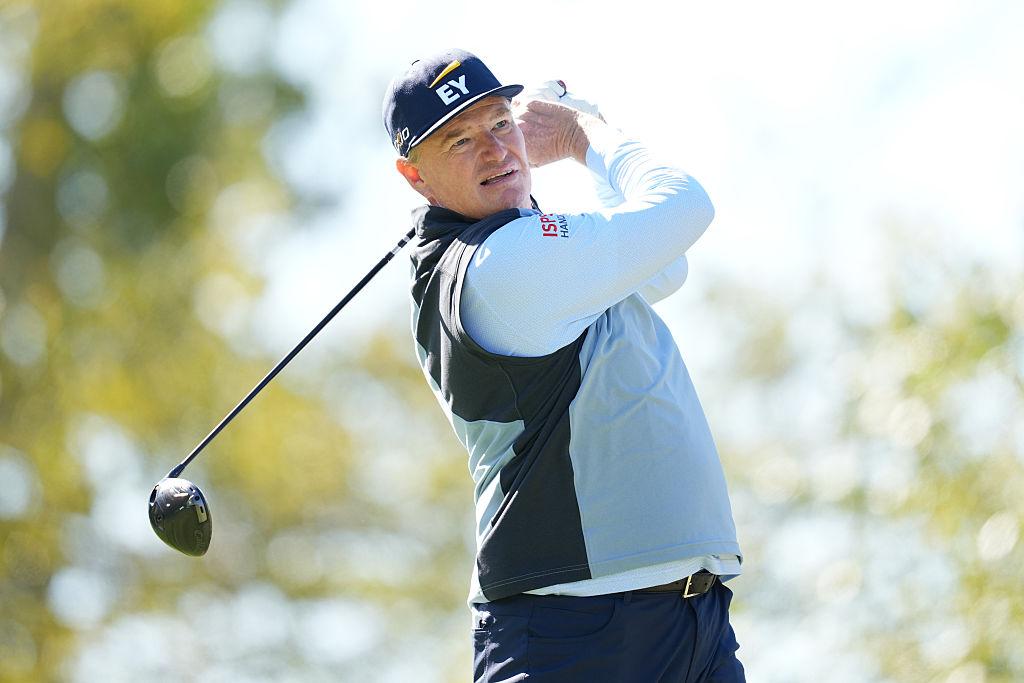
“Fijian golfer Vijay Singh won the 2026 SAS Championship with a total of nine under par, finishing two strokes ahead of South African legend Ernie Els, who secured second place after closing with a three-under-par 69. Els’s performance provided a major South African highlight at the tournament, while fellow South Africans Retief Goosen and Darren Fichardt also competed in the event.”
Ernie Els delivers a strong South African performance as Vijay Singh wins the SAS Championship
A memorable week for South African golf
South African golf received an encouraging international spotlight when Ernie Els finished second at the 2026 SAS Championship, challenging Fiji’s Vijay Singh in the PGA Tour Champions event in North Carolina, United States. The tournament, played at Prestonwood Country Club from 16 to 18 October, brought together experienced professionals competing on the senior circuit, where consistency, course management and composure can prove decisive.
Singh ultimately secured the title with a two-stroke victory, but Els’s performance was an important result for South African golf. The four-time major champion demonstrated that he remains competitive against accomplished players, delivering a closing round that kept him firmly in contention.
The result also offered a reminder of South Africa’s continuing presence in international professional golf. Els, Retief Goosen and Darren Fichardt represented South African interests at the tournament, providing local golf supporters with several familiar names to follow.
Vijay Singh produces a decisive winning performance
Singh entered the final round seeking another victory after a challenging season. The 63-year-old former world number one delivered three consecutive rounds of 69, each three strokes below par, to finish on nine under par overall.
His performance was built on steady scoring rather than a single spectacular round. Across three days, Singh maintained the consistency required to remain near the top of the leaderboard before making his decisive move during the final round.
According to the published report, Singh collected four birdies during a six-hole stretch around the turn. That scoring sequence helped him move ahead of his rivals and establish control of the contest.
However, finishing the job required patience. After gaining the advantage, Singh recorded six consecutive pars to reach the final hole without surrendering his lead. That stretch illustrated the importance of protecting a tournament-winning position when competitors are attempting to close the gap.
Singh’s final score of nine under par secured his sixth PGA Tour Champions title and his first victory on the circuit since the 2023 Ally Challenge. His success was particularly notable because he had not recorded a top-10 finish earlier in the 2026 season, according to the report.
After the victory, Singh acknowledged that the week had presented difficulties. Cold conditions had raised concerns about his back before the final round, yet he managed to maintain his composure and complete the tournament successfully.
Ernie Els keeps South Africa in contention
Els emerged as Singh’s closest challenger, finishing second on seven under par. He also recorded a three-under-par 69 in the final round, matching the winner’s closing score.
His tournament included rounds of 69, 71 and 69. Those scores reflected a largely consistent performance, although the second-round 71 left him with ground to recover during the closing stages.
The final round gave Els an opportunity to apply pressure, but Singh’s scoring around the turn proved difficult to overcome. The South African nevertheless completed his round with a strong score and secured the runner-up position.
Finishing second against a field of experienced international professionals is a meaningful result, particularly on a circuit where players have extensive experience handling pressure and adapting their games to changing conditions.
Els has enjoyed a distinguished career that includes four major championship victories and numerous international successes. His achievements have helped establish South Africa as one of the countries associated with producing elite golfers capable of competing around the world.
Although this tournament did not produce another victory for Els, the result demonstrated the value of experience and competitive resilience. His performance also gave South African supporters a positive development to follow during the international golf season.
Importantly, the available report confirms the finishing position and scores. It does not establish that Els has won a new title or secured a particular qualification through this result. The significance lies in his second-place finish and the quality of his challenge against Singh.
Retief Goosen and Darren Fichardt add to South African interest
Els was not the only South African golfer participating in the SAS Championship. Retief Goosen, another major champion, also featured in the tournament, while Darren Fichardt contributed to the South African presence in the field.
Goosen, who led after the opening round, finished tied for 15th on three under par. His position illustrated how quickly the leaderboard can change over a three-round tournament, particularly when several experienced golfers are separated by only a few strokes.
Fichardt finished tied for 22nd on one under par. Although neither player matched Els’s final placing, their participation gave South Africa several representatives in a competitive international field.
For professional golfers, tournament performance involves more than the opening round. Maintaining momentum, recovering from mistakes and managing the final stretch can determine whether an early lead becomes a realistic title challenge.
Goosen’s opening-round position suggested that he had the ability to compete near the top. However, the subsequent rounds did not produce a finish comparable to Els’s runner-up result.
Fichardt’s finish similarly offered experience and competition at international level, even without a place among the leading contenders.
Together, the three South Africans illustrated the depth of experience available within the country’s professional golfing community. Their results also show why individual round scores must be considered alongside the final leaderboard when assessing a player’s overall performance.
Why the result matters for South African golf
South Africa has a substantial tradition of producing professional golfers who succeed in major championships, international tours and team competitions. Els and Goosen are among the established figures whose careers have helped strengthen that reputation.
Their continued participation in senior professional tournaments allows fans to follow familiar players beyond the main stages of their careers. The PGA Tour Champions circuit provides an opportunity for eligible professionals to continue competing in structured tournaments against other experienced golfers.
For South African supporters, Els’s second-place finish offered a particularly compelling storyline because it placed a home-country sporting figure directly in contention for an international title.
Results such as this can also maintain interest in professional golf among audiences who remember the achievements of established champions. A competitive performance does not need to end with a trophy to attract attention, especially when the player remains close to the winner throughout the final stages.
Nevertheless, a single runner-up finish should not be treated as proof of a broader change in the state of South African golf. Evaluating the country’s current strength requires examining results across multiple tournaments, player rankings, emerging talent and performances on different professional tours.
The SAS Championship provides one useful example of South African representation at international level, rather than a complete picture of the country’s golfing progress.
The importance of consistency on the senior circuit
The tournament also demonstrated how consistency can outweigh isolated moments of brilliance. Singh’s three consecutive rounds of 69 created a reliable scoring foundation and allowed him to win without needing a dramatically lower score in the final round.
Els followed a similar pattern, producing two rounds of 69 around a second-round 71. His final-round performance kept him in contention, but Singh’s earlier advantage ultimately proved decisive.
At professional level, golfers must balance aggression with risk management. Attacking a difficult pin can create a birdie opportunity, but it can also lead to a bogey if the shot misses its intended target.
The ability to identify when to attack and when to play conservatively is particularly important late in a tournament. Players who lead must protect their advantage, while those chasing the title need to identify opportunities without allowing pressure to undermine their decisions.
Singh’s six consecutive pars after his birdie run were a practical example of this principle. Once he had established a lead, avoiding unnecessary mistakes became just as important as making birdies.
For aspiring golfers, the tournament offered a useful lesson: consistent execution over several rounds can be more effective than relying on occasional exceptional scoring.
The wider professional golf calendar
The SAS Championship took place during a busy period for professional golf, with South African golfers also competing on other international circuits.
Earlier in October, the DP World India Championship in New Delhi provided another opportunity for South African players to compete abroad. JC Ritchie finished tied for fifth on 13 under par, while Jayden Schaper placed in a tie for 15th on 10 under par.
These results show that South African participation in professional golf extends beyond a single tour or tournament. Players compete across different events, courses and international schedules, building experience and pursuing stronger finishes.
At home, the Sunshine Tour remains an important platform for professional competition and player development. The tour’s published schedule also listed the Stella Artois Players Championship at Glendower Golf Club in Johannesburg for 21–25 October 2026.
The combination of domestic and international tournaments gives golf supporters several opportunities to follow established professionals and monitor developing talent.
However, the outcome of one competition should not be used to predict the results of another. Course layouts, weather, field strength and player form vary considerably, meaning that each tournament presents a new challenge.
What comes next for Els and South African golf?
Els’s runner-up result gives him a positive performance to build on, although the available reporting does not establish his next tournament commitment or guarantee another top finish.
For South African golf supporters, the next step is to monitor official tournament schedules, confirmed entry lists and published leaderboards. These sources provide reliable information about when players are competing and how their performances develop.
The same approach is important when following younger professionals. While established names attract considerable attention, sustained progress across different tours can also reveal which players are developing into future contenders.
GolfRSA, the Sunshine Tour and international tour organisers provide useful information about fixtures, competitive results and the broader development of the game.
South African golf’s future will depend on several factors, including access to coaching, junior development, competitive opportunities and the ability of professionals to perform consistently at international level.
Els’s result is encouraging within that wider picture, but it should be viewed as one performance in an ongoing season rather than a definitive assessment of national progress.
Conclusion
Vijay Singh’s victory at the 2026 SAS Championship was the week’s decisive result, with the Fijian finishing on nine under par to claim his sixth PGA Tour Champions title. Ernie Els’s second-place finish on seven under par provided the leading South African storyline, while Retief Goosen and Darren Fichardt also represented the country in North Carolina.
The tournament highlighted the importance of consistency, patience and decision-making under pressure. It also demonstrated that experienced South African golfers remain visible participants in international professional competition.
Although the event concluded on 18 October rather than 20 October, its outcome remains a relevant recent golf story for South African sports coverage. The result gives readers a verified update on Els’s performance while providing context about the country’s wider presence on the professional circuit.
For South African golf fans, the central takeaway is clear: Els delivered a strong challenge, Singh proved the most consistent finisher, and the international season continues to offer opportunities for South African professionals to compete and make headlines.



