




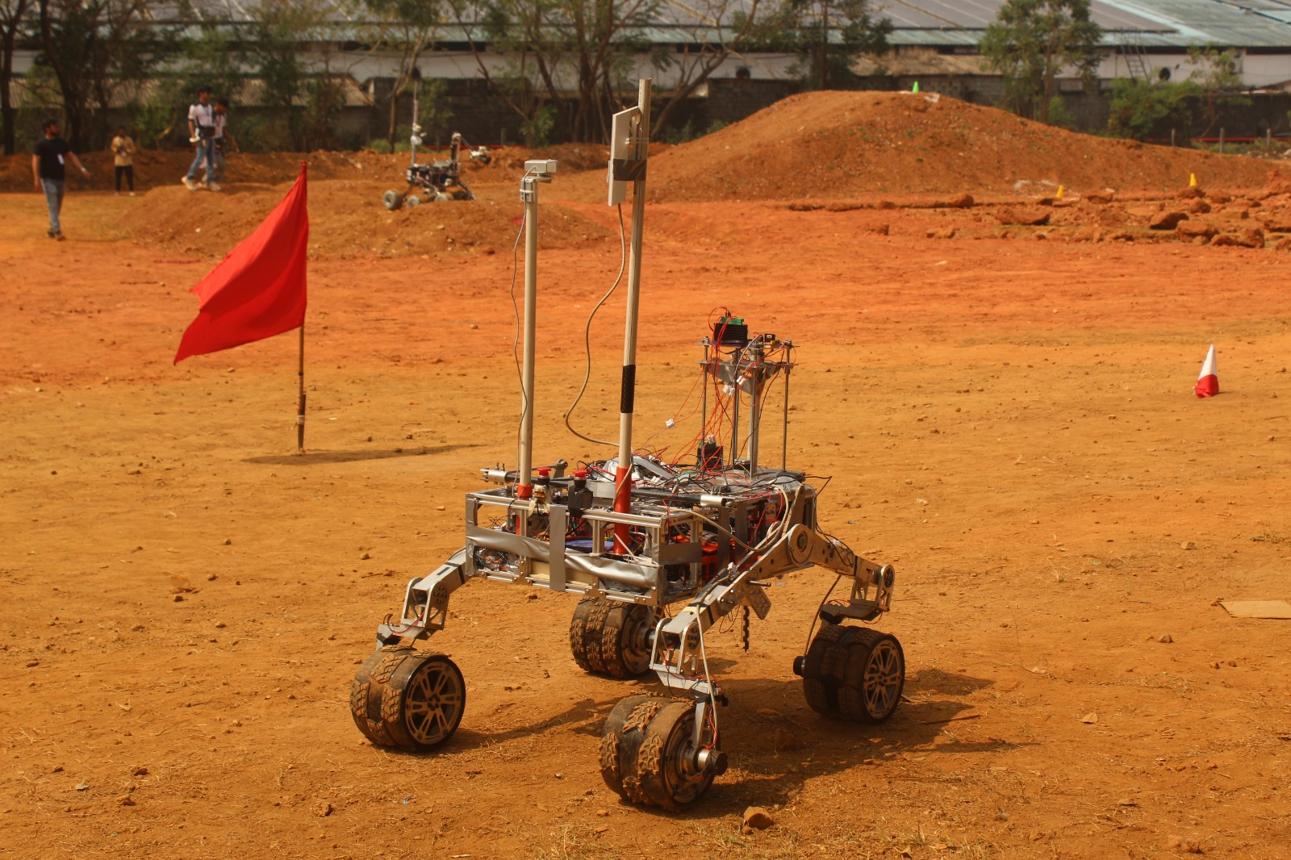
“Around 120 young innovators from South Africa, Kenya and Zimbabwe gathered at the South African National Space Agency’s Hartebeesthoek facility to test self-built Mars rover prototypes in the 2026 Cars4Mars African Rover Challenge. The competition combined robotics, artificial intelligence, computer vision, electronics and software engineering, giving participants practical experience in developing and controlling autonomous robotic systems.”
Africa’s Young Innovators Test Mars Rovers at SANSA as Robotics and AI Skills Take Centre Stage
South Africa has provided a distinctive testing ground for the next generation of African robotics innovators, with young engineers and learners recently putting self-built Mars rover prototypes through demanding missions at the South African National Space Agency (SANSA) facility in Hartebeesthoek.
The event formed part of the Cars4Mars African Rover Challenge – Mars Stage Final 2026, an initiative designed to give students and school learners practical experience in robotics, artificial intelligence, electronics, software engineering and space technology. According to SANSA, about 120 participants from South Africa, Kenya and Zimbabwe took part in the physical final, representing 18 finalist teams.
The development is significant because the competition moves robotics education beyond classroom theory. Instead of simply learning programming concepts or studying engineering principles, participants were required to design, construct, test and operate functioning robotic machines under challenging conditions.
A Mars Yard in South Africa
The competition took place at SANSA’s site in Hartebeesthoek, where a specially constructed Mars Yard provided an environment designed to resemble the difficult terrain that a rover could encounter on another planet.
SANSA said more than 40 tonnes of red sand, sponsored by AFRIMAT, were used to create the Mars-like testing environment. The facility allowed teams to test whether their machines could move across uneven terrain while completing specific objectives.
The setting was more than a visual recreation of Mars. It created an engineering challenge in which teams had to think about mobility, remote control, cameras, software, sensors, artificial intelligence and the physical design of their machines.
For young participants, this meant that engineering problems became practical rather than theoretical. A rover that appeared to work during testing could behave differently once placed on loose sand, uneven ground or around obstacles.
That combination of hardware and software is one of the defining characteristics of modern robotics.
From an online competition to a physical final
The 2026 Cars4Mars competition began on 1 May and ran for approximately five months before reaching the Mars Stage Final. SANSA reported that approximately 100 teams from 11 African countries participated in the initial online stage, with 18 finalist teams eventually advancing to the physical competition.
Participants were given time to develop their rover concepts before bringing them to Hartebeesthoek.
The process required teams to work across several disciplines. A successful rover could not depend on only one skill. Mechanical engineering was needed to construct the machine, electronics were necessary to power and control it, software was required for operation, while artificial intelligence and computer vision became important during autonomous missions.
This multidisciplinary approach reflects the direction of the wider robotics industry, where engineers increasingly need to combine physical machines with sophisticated software.
The Traversal Mission
One of the central tests was the Traversal Mission.
Teams remotely operated their rovers across uneven terrain and were required to locate and transport objects placed on the course by judges. They could use camera-based visual feedback or direct observation to control and manoeuvre their machines.
The mission tested basic but important capabilities of robotic systems.
A rover must be able to move accurately, respond to commands and remain stable while navigating an unpredictable surface. At the same time, its operators need to understand how the machine responds to different terrain conditions.
These are skills that have applications beyond planetary exploration.
Robotic systems are increasingly being developed for environments where human workers may face difficult, dangerous or expensive conditions. Similar principles can be applied in mining, agriculture, infrastructure inspection, disaster response and industrial automation.
For South Africa, a country with significant mining, manufacturing and agricultural sectors, experience in these areas could have applications well beyond space exploration.
Artificial intelligence becomes part of the challenge
The second major component was the AI Autonomous Mission.
This stage required teams to demonstrate the ability of their rover systems to use artificial intelligence and computer vision. The machines had to identify objects visible through their cameras, including a hammer, tennis ball, traffic cone and balloons in different colours. Additional points were available for systems capable of determining an object’s location within the camera image using AI or computer-vision algorithms.
This represents an important step from remotely controlled robotics toward autonomous robotics.
In a remotely controlled system, a human operator makes decisions and sends instructions to the machine. In an autonomous system, software can analyze information from sensors or cameras and make certain decisions without continuous human intervention.
Computer vision is particularly important because it allows robots to interpret visual information from their surroundings.
A rover equipped with a camera can potentially distinguish objects, identify obstacles and determine where something is located. When combined with movement systems and decision-making software, these capabilities can allow a robot to navigate more independently.
South African teams among the finalists
Although the Cars4Mars competition attracted teams from several African countries, South African institutions featured strongly among the finalists.
Zimbabwe’s Cyberstorm from Milestone High School won first place. South Africa’s Inadeptus Mechanicus, representing Rhodes University and Stellenbosch University, finished second, while Tech Tonic from Bryanston High School took third place.
South African teams also received awards in specific categories.
Robo TechAura from Tshwane University of Technology was recognised as Best in AI Mission, while Wall-E, also from Tshwane University of Technology, received the Best in Traversal Mission award.
The Best Creativity award went to Techne-Cality from the Open Window Institute for Creative Arts. Kenya’s Jomo Kenyatta University of Agriculture and Technology won Best Design with its Vulcan team.
These results demonstrate that the competition was not limited to a single measure of performance. Teams could demonstrate strengths in artificial intelligence, navigation, design and creativity.
Building practical engineering skills
One of the central purposes of the Cars4Mars programme is to provide young people with practical experience.
SANSA describes the competition as an annual, volunteer-led robotics initiative open to high school learners as well as university and college students across Africa. Participants receive free mentoring while developing their rover prototypes.
That mentoring component is particularly relevant to robotics education because developing a functioning robot requires access to knowledge from multiple disciplines.
Students must understand mechanical structures, motors, power systems, electronic components, wireless communication, programming and increasingly AI.
Competitions such as Cars4Mars can therefore expose young people to engineering problems that may not be encountered through conventional classroom assignments.
The event also demonstrates the value of failure and iteration. A machine may fail to climb an obstacle, lose traction, misidentify an object or respond incorrectly to commands. Engineers then have to identify the cause and modify the design.
That process resembles real-world engineering more closely than a traditional examination.
Hartebeesthoek to become a continuing robotics platform
Another important development is the decision to establish Hartebeesthoek as a permanent venue for future Cars4Mars finals.
SANSA said its partnership with Cars4Mars will create a continuing platform where young African engineers, scientists and space enthusiasts can develop practical skills.
The long-term value of such a facility could extend beyond the annual competition.
A permanent testing environment gives educational institutions and young innovators a place where robotic systems can be designed and evaluated under realistic conditions. Over time, repeated competitions could also create a community of students, mentors, engineers and technology companies.
This could help connect education with industry by giving young people opportunities to demonstrate practical capabilities.
Support from technology partners
The competition was supported by several organizations.
SMD Technologies sponsored Creality 3D printers for the top three teams, while RS South Africa provided vouchers to help those teams purchase electronics. SIMTEQ Engineering contributed 3D-printed trophies and professional simulation software. Other supporting organisations included BYMEDICAL, Scientific Technical Labs, MSI ZA, Home Technologies, Stelltron, Counter Space Learn, Woodline Branding Solutions, ER24 and Vision Dynamics.
The involvement of technology companies is important because robotics development requires physical components as well as software.
3D printing, for example, can allow students to produce custom mechanical parts relatively quickly. Simulation software can allow teams to test designs before physically manufacturing every component.
Together, these technologies can reduce the barrier between an idea and a working prototype.
Robotics as a wider African opportunity
The Cars4Mars challenge also highlights the growing importance of robotics education across Africa.
Robotics is no longer limited to industrial factory systems. Robots are increasingly being explored for agriculture, mining, logistics, healthcare, environmental monitoring, disaster response, and scientific research.
Africa has its own distinctive engineering challenges. In some situations, robotic systems could be designed specifically to operate in environments where conventional infrastructure is limited or where human workers face significant risks.
Training young engineers to build such systems could therefore contribute to broader technological capacity.
The Cars4Mars competition is not producing space-ready machines. Its purpose is educational. Nevertheless, the skills developed through building these relatively small robotic platforms can be transferred to other technological fields.
Looking beyond Mars
The most important element of the competition may ultimately be what happens after the rovers leave the Mars Yard.
A student who learns how to program a robot to recognize an object could later apply computer vision to agricultural monitoring. Someone who develops a reliable remote-control system could work on mining or industrial equipment. Another participant who learns mechanical design could move into manufacturing or product development.
In this sense, the Mars rover is a platform for learning rather than simply an end product.
The event also brings together different African countries. Participants from South Africa, Kenya and Zimbabwe competed at the same venue, while the wider competition attracted teams from 11 African countries during its initial stage.
That regional dimension provides opportunities for knowledge sharing and collaboration among young engineers.
The wider significance for South Africa
South Africa already has established capabilities in science, engineering, mining technology, telecommunications and space-related research. Programmes such as Cars4Mars provide an opportunity to connect those capabilities with a younger generation.
The SANSA event shows how robotics education can combine several technological fields in a single practical challenge.
Artificial intelligence provides the software intelligence. Computer vision allows machines to interpret their surroundings. Electronics connect sensors and motors. Mechanical engineering gives the rover its physical structure. Software engineering brings the different components together.
The result is a small but highly integrated technological system.
As robotics becomes increasingly important internationally, developing people who understand these systems could become an important part of building future technical capacity.
The 2026 Cars4Mars final therefore represents more than a competition involving miniature Mars rovers. It is an example of how hands-on engineering programmes can give African students opportunities to design, build, test and improve technology themselves.
For South Africa, the establishment of Hartebeesthoek as a continuing Cars4Mars venue provides a foundation for future competitions and training. For the participating students, the experience offers something equally valuable: the opportunity to turn concepts in robotics, artificial intelligence and engineering into machines that must actually work.



