




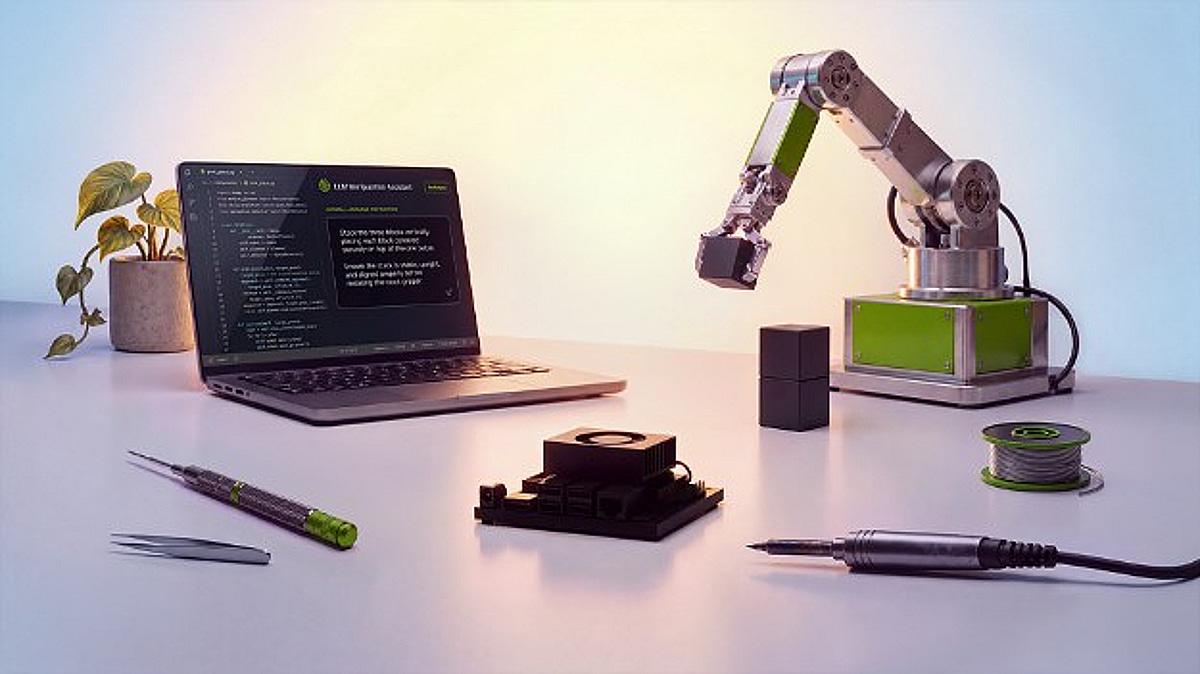
“RS South Africa is supporting NVIDIA’s Jetson Orin Nano 2, a compact edge-AI computing platform designed for robotics, machine vision, drones and other intelligent industrial applications, with local availability expected in the first half of 2027. The platform offers up to 78 TOPS of AI compute, 8GB of memory and an eight-core Arm CPU, while NVIDIA says it can provide twice the inference performance of the previous Jetson Orin Nano Super at the same maximum power envelope and 40% lower power consumption at equivalent performance.”
South Africa’s edge-computing ambitions gain momentum
South Africa’s technology industry is increasingly looking beyond conventional cloud computing toward a model in which artificial intelligence can operate closer to where data is generated. That shift is at the centre of a new development involving RS South Africa and NVIDIA’s Jetson Orin Nano 2, a compact computing platform designed for artificial intelligence, robotics and machine-vision applications.
A report published on 27 September 2026 highlights RS South Africa’s support for the platform and its potential applications across South African industrial and engineering environments. The platform is expected to become available during the first half of 2027.
The development is significant because edge computing changes where computational work takes place. Instead of sending every piece of data to a remote cloud data centre for processing, an edge device can analyse information locally. For applications such as autonomous machines, industrial cameras, drones and robots, this can reduce latency and allow systems to respond more quickly.
The Jetson Orin Nano 2 is designed specifically around this type of workload.
A smaller computer with substantially more AI capability
NVIDIA’s new platform combines an eight-core Arm CPU, 8GB of memory and an Ampere GPU architecture capable of delivering up to 78 trillion operations per second, or TOPS, for INT8 AI workloads. The platform operates within a 15W-to-40W power range and is designed to maintain compatibility with NVIDIA’s broader Jetson software ecosystem.
According to the announcement, the Jetson Orin Nano 2 provides twice the inference performance of the previous Jetson Orin Nano Super while retaining a similar compact form factor and 40W power envelope. NVIDIA also says the platform can achieve equivalent performance while using 40% less power.
For businesses deploying computing equipment outside traditional data centres, power consumption can be particularly important. A system installed on a robot, drone or remote industrial machine cannot necessarily rely on the same electrical infrastructure available inside a conventional server room.
Lower power requirements can therefore expand the number of environments in which sophisticated AI can be deployed.
RS South Africa Sales Director Erick Wessels said South African businesses are increasingly examining how artificial intelligence, robotics and automation can change industrial operations. He described access to capable edge-computing platforms as increasingly important as these technologies develop.
Why edge computing matters
Cloud computing remains important for large-scale data processing, model training and enterprise applications. However, cloud infrastructure is not always the most practical solution when an application requires immediate decisions.
Consider an industrial camera inspecting products on a manufacturing line. The camera may capture thousands of images, but the system needs to identify a defective product immediately. Sending every image to a remote data centre introduces connectivity requirements and potentially additional latency.
An edge-AI computer can instead analyse the video locally and trigger an action almost immediately.
The same principle applies to autonomous robots. A machine navigating a warehouse, mine or factory may need to recognise obstacles and react in real time. Dependence on a remote server could create unnecessary delays or leave the system vulnerable when connectivity is interrupted.
This is one reason compact AI computers are attracting attention across industrial technology.
Potential applications in South Africa
The South African economy provides several potential environments for edge AI.
Mining is one example. Mines frequently operate in environments where equipment, vehicles and workers must be monitored continuously. AI-enabled cameras and autonomous machines could potentially analyse conditions locally and identify objects, movement or equipment abnormalities.
Agriculture is another potential application. Large farms can use drones and computer-vision systems to inspect crops, identify variations and collect information across extensive areas. Processing some of that information at the edge can reduce the amount of data that needs to be transferred to a central server.
Manufacturing can also benefit from local machine vision. Cameras connected to edge computers can inspect products, identify defects and monitor production processes.
Logistics provides another use case. Robots and automated systems can process sensor and camera information locally as they move through warehouses or distribution facilities.
The Jetson Orin Nano 2 is designed for precisely these kinds of applications, including delivery and inspection drones, robots and vision-AI systems.
The importance of the software ecosystem
Hardware performance is only one part of an AI platform.
Developers also need software tools, libraries, development environments and models that allow them to turn computing hardware into practical products. NVIDIA’s Jetson ecosystem is intended to provide those tools alongside the hardware.
The Jetson Orin Nano 2 uses NVIDIA’s open AI software stack and associated development ecosystem. This gives developers a pathway from experimentation to deployment, particularly for applications involving computer vision and robotics.
For South African technology companies, universities, engineering firms and start-ups, local distribution can also matter. Access to hardware through a regional supplier can simplify procurement, technical support and future deployment.
RS operates as a global distributor of industrial and electronic technology products and has an established relationship with NVIDIA. The company says its role will allow customers to explore the new platform and prepare for future ordering opportunities.
From AI experimentation to real-world deployment
Artificial intelligence has moved rapidly from research laboratories into business environments. However, deploying AI successfully in physical environments creates different requirements from running an AI application on a desktop computer or cloud server.
Robots need to respond to physical surroundings. Drones need to process visual information while operating under strict weight and power limitations. Industrial machines must often operate continuously and reliably.
That makes computing efficiency important.
The Jetson Orin Nano 2’s combination of processing capability, compact size and power efficiency is intended to address those requirements. Its specifications suggest that more AI processing can be performed directly on smaller machines without requiring a large computer or constant connection to cloud infrastructure.
For South Africa, the development also connects to a broader technology trend. Local businesses are increasingly investigating artificial intelligence, automation and advanced digital infrastructure as part of their competitiveness strategies. Recent South African technology reporting has highlighted growing IT expenditure, AI investment and infrastructure development in the country.
Availability is still in the future
One important limitation is timing.
The Jetson Orin Nano 2 is not yet generally available in South Africa. RS South Africa’s announcement indicates that the platform is expected to become available in the first half of 2027.
That means companies interested in the technology currently have an opportunity to evaluate possible applications and prepare development projects rather than immediately deploy the new hardware at scale.
The period before availability may also allow engineers and developers to determine where edge AI can produce practical value. Successful implementation will depend not only on computing performance but also on suitable sensors, software, connectivity, cybersecurity, maintenance and skilled personnel.
What it means for South African computing
The RS South Africa announcement reflects a wider change in computing architecture. AI is increasingly moving away from a model in which all intelligence resides in central data centres.
Instead, computing is becoming distributed.
Large cloud systems can train and operate sophisticated models, while smaller edge computers can handle specific AI tasks close to users, machines and physical environments.
For South Africa, this approach could have applications in sectors ranging from manufacturing and mining to agriculture, logistics and infrastructure.
The significance of the Jetson Orin Nano 2 therefore extends beyond the specifications of a single computer. It represents the continuing effort to make AI processing smaller, more efficient and easier to integrate into physical machines.
As the platform moves toward its expected 2027 availability, South African developers and industrial organisations will have an opportunity to assess whether its combination of AI performance, power efficiency and compact design can translate into practical applications.
The immediate story is therefore not simply about a new processor or development board. It is about where computing happens next: increasingly, inside the machines, vehicles, robots and devices that interact directly with the physical world.



