




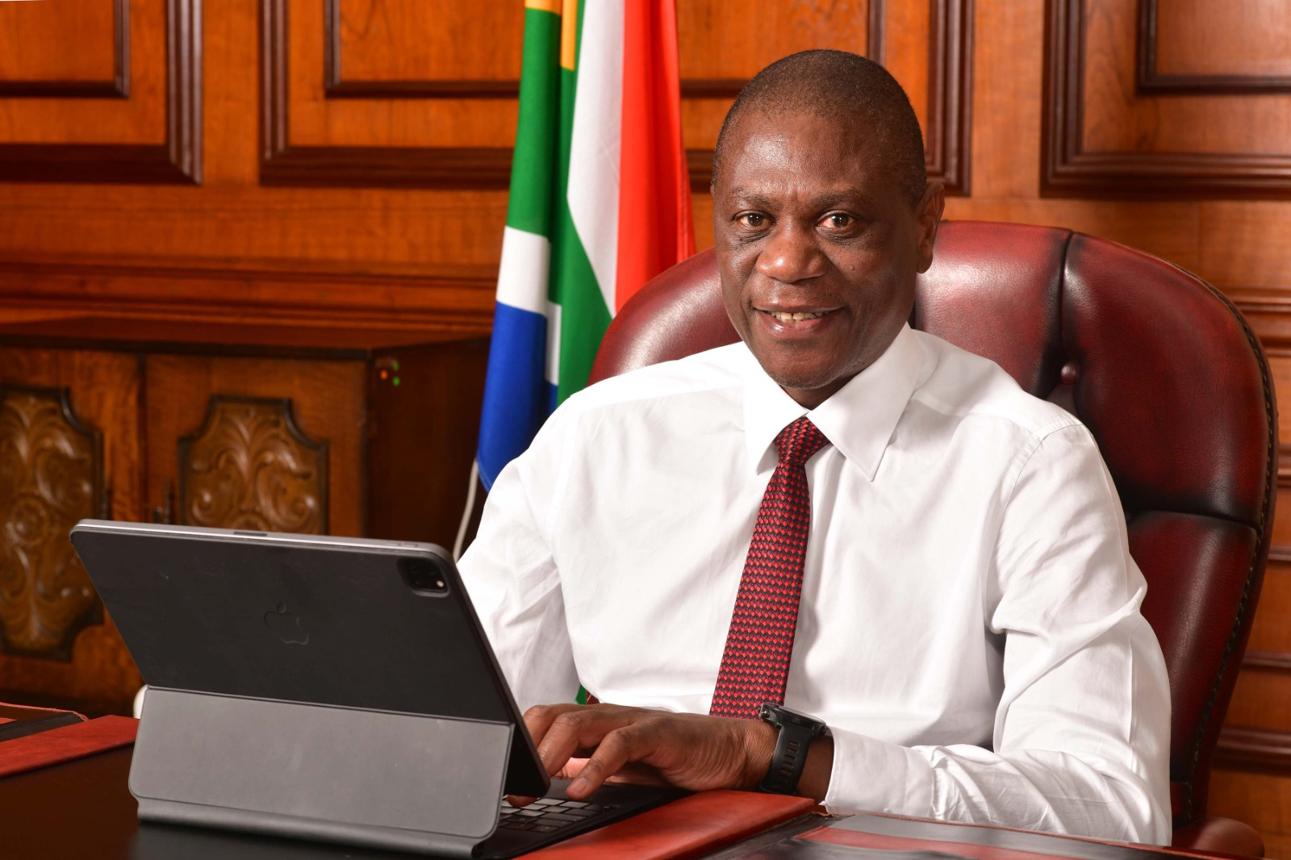
“Deputy President Paul Mashatile is scheduled to brief the National Council of Provinces (NCOP) on government interventions to improve municipal financial management, strengthen local government institutions and address persistent service-delivery challenges across South Africa. The update covers support for 66 struggling municipalities, water security, municipal turnaround plans, crime prevention and initiatives to expand employment and skills opportunities for young people.”
South Africa Intensifies Municipal Reform Agenda as Mashatile Updates Parliament on Financial Sustainability, Water Security and Service Delivery
PRETORIA, SOUTH AFRICA – 26 NOVEMBER 2026
South Africa’s efforts to strengthen local government, improve municipal financial management and address persistent service-delivery challenges are receiving renewed attention as Deputy President Paul Mashatile engages the National Council of Provinces (NCOP) on government interventions targeting struggling municipalities.
The parliamentary engagement, scheduled for Thursday, 26 November 2026, focuses on the government’s response to institutional weaknesses, financial instability, water supply challenges and inadequate delivery of essential services in municipalities across the country.
According to an official announcement published by the South African government on 25 November, Mashatile is expected to provide an update on interventions aimed at stabilising 66 municipalities identified in 2023 as requiring urgent support. The programme includes municipal turnaround compacts monitored by National Treasury and provincial governments, alongside wider reforms intended to improve governance, financial management and administrative capacity.
The engagement is significant because municipalities are responsible for delivering services that directly affect households, businesses and communities. These include water, sanitation, electricity distribution, refuse removal, local infrastructure maintenance and other essential functions.
For many residents, the effectiveness of government is experienced most directly at municipal level. Consequently, municipal financial difficulties and administrative failures can have immediate consequences for everyday life.
Government targets struggling municipalities
The government’s intervention programme reflects continuing concerns about the financial and institutional condition of local government.
The identification of 66 municipalities requiring urgent support highlights the scale of the challenge facing national and provincial authorities. Municipalities differ considerably in their financial resources, economic circumstances, population sizes and administrative capabilities.
Some local authorities have substantial revenue bases, while others depend heavily on government transfers to finance basic services and infrastructure.
The municipal turnaround compacts are intended to provide a coordinated framework for addressing these challenges. National Treasury and provincial governments are expected to monitor implementation, strengthening oversight and ensuring that intervention plans translate into measurable improvements.
However, the effectiveness of these arrangements will depend on implementation. Financial recovery requires credible budgets, improved revenue collection, responsible expenditure, effective procurement and appropriate accountability mechanisms.
It also requires municipalities to maintain reliable records, pay suppliers and ensure that available funding reaches the services for which it was allocated.
Financial management remains a central policy challenge
Municipal financial sustainability is one of the most important issues facing South Africa’s local government system.
The Parliamentary Budget Office’s November 2026 assessment of the adjustments budget and Division of Revenue amendments provides evidence of the financial pressures affecting municipalities.
Its assessment reports that 62 municipalities, representing 24% of municipalities, were in severe financial distress during the 2024/25 financial year. It also indicates that only 35% had good financial health, while 45% adopted adjusted unfunded budgets.
These figures demonstrate why financial recovery remains a priority for government.
Unfunded budgets create serious difficulties because municipalities may approve spending commitments without having sufficient revenue to meet their obligations. This can contribute to delayed infrastructure projects, unpaid suppliers, deteriorating services and growing debt.
Revenue collection is another significant concern.
According to the Parliamentary Budget Office assessment, the municipal collection rate fell to 63.9% in 2025/26, compared with 72.9% in 2024/25. Consumer debt increased to R484.5 billion, while outstanding creditors reached R185.2 billion.
This situation creates a difficult financial environment. Municipalities need revenue to maintain infrastructure, employ skilled personnel and provide essential services. However, weak collection makes it increasingly difficult to meet these responsibilities.
Improving billing systems, addressing illegal connections, reducing water and electricity losses and strengthening debt-management procedures are therefore important components of municipal reform.
Government must also distinguish between households that cannot afford basic services and customers who can pay but fail to meet their obligations.
Water security becomes a major government priority
Water security is another central component of Mashatile’s scheduled parliamentary update.
The government has identified persistent water supply interruptions as a major challenge, particularly in rural and underserved communities.
The National Water Action Plan, released by President Cyril Ramaphosa on 23 July 2026, provides a framework for addressing the country’s water infrastructure and institutional challenges.
The plan focuses on increasing investment, improving municipal water management, strengthening regulation, addressing corruption and ensuring that water revenues are available for maintaining essential infrastructure.
One important issue concerns the relationship between municipal water revenues and infrastructure maintenance.
Where revenue collected from water services is used for unrelated municipal expenditure, insufficient funding may remain for repairing leaking pipes, maintaining treatment facilities and upgrading distribution networks.
The National Water Action Plan therefore promotes ring-fencing water revenue to ensure that resources are directed towards sustaining water infrastructure.
Implementation will require coordination between national government, provincial authorities, municipalities, water boards and other stakeholders.
It will also require technically qualified personnel, reliable infrastructure assessments and transparent project management.
The success of the policy should ultimately be measured through improvements in the reliability, accessibility and quality of water services.
Revised local government policy seeks structural reform
The current interventions form part of a broader government effort to transform the local government system.
In October 2026, President Ramaphosa unveiled the Revised White Paper on Local Government, which proposes changes to municipal powers, institutional responsibilities, financial management and service-delivery arrangements.
Among the proposals is a differentiated approach to municipal responsibilities.
This recognises that metropolitan municipalities, secondary cities and rural municipalities do not have identical administrative capacity or revenue-generating potential.
Under the proposed approach, responsibilities would be aligned more closely with the ability of individual municipalities to perform them effectively.
The White Paper also proposes stronger regulation of water and electricity services, including separating the roles of service authorities and service providers and introducing compulsory licensing requirements for providers.
These proposals could have important implications for how municipalities organise and manage essential services.
The central policy question is how to strengthen accountability without weakening local government institutions or disrupting services.
The revised framework seeks to establish clearer responsibilities between national, provincial and municipal authorities.
For residents, the practical test will be whether these changes improve service reliability, infrastructure maintenance and the responsiveness of local authorities.
National Treasury strengthens financial accountability
Financial oversight remains essential to the government’s municipal recovery programme.
National Treasury has previously taken steps to address financial non-compliance, including temporarily withholding equitable-share transfers from selected municipalities in July 2026.
The intervention followed concerns about failures to comply with the Municipal Finance Management Act and inadequate action to address unauthorised, irregular, fruitless and wasteful expenditure.
The decision also raised concerns about the potential consequences for communities dependent on municipal services.
In parliamentary discussions reported on 19 November, Mashatile indicated that government wanted to consider alternative accountability measures rather than repeatedly withholding equitable-share funding.
He said National Treasury and the Department of Cooperative Governance and Traditional Affairs were considering ways to hold municipal officials accountable without placing essential services at risk.
This highlights an important policy balance.
Government needs to enforce financial legislation and ensure that public money is managed responsibly. At the same time, interventions must avoid unnecessarily affecting poor households and communities that depend on municipal support.
Effective accountability should therefore target administrative failures and misconduct while protecting funding intended for essential services.
Crime prevention and community safety
Mashatile’s scheduled NCOP update also includes government efforts to address violent crime, illegal firearms, extortion, gang violence and organised crime.
The official announcement identifies several interventions, including specialised anti-gang units, improved intelligence-sharing between provinces, stronger community policing and integrated law-enforcement operations.
Although policing and criminal justice involve responsibilities beyond municipalities, local government plays an important role in creating safer communities.
Municipal planning, street lighting, public infrastructure, community facilities and local partnerships can contribute to safer environments.
Extortion and organised crime can also affect businesses, construction projects and municipal infrastructure development.
Consequently, coordinated law-enforcement activities and stronger community engagement are important elements of broader public policy.
Youth employment and skills development
Youth development is another issue expected to feature in the parliamentary engagement.
The government intends to expand opportunities for young people, particularly those in rural and disadvantaged communities, through access to digital, technical and green-economy skills.
These initiatives reflect the need to connect education and skills development with changing labour-market requirements.
Digital technology, renewable energy, infrastructure development and environmental services create demand for specialised skills.
Municipalities can contribute through infrastructure programmes, partnerships with training institutions and initiatives that connect young people with practical employment opportunities.
However, the long-term effectiveness of these programmes will depend on whether training leads to meaningful employment, entrepreneurship and sustainable economic participation.
Temporary opportunities may provide valuable experience, but they need to complement pathways towards longer-term employment.
Parliamentary oversight and implementation
The NCOP engagement provides an opportunity for Parliament to examine how national government is coordinating municipal interventions and whether the existing policy framework is producing results.
The NCOP has an important constitutional role in representing provincial interests and considering matters affecting provincial and local government.
Its oversight responsibilities are particularly relevant where municipal problems require cooperation between different spheres of government.
The implementation of turnaround compacts, water infrastructure programmes and financial reforms will require clear performance indicators and regular reporting.
Parliamentary scrutiny can help establish whether public funding is being used effectively and whether responsible institutions are meeting their obligations.
It can also provide an opportunity to identify implementation obstacles and consider whether additional policy or legislative measures are necessary.
What the reforms mean for South African communities
The government’s municipal reform programme addresses issues that affect the daily lives of millions of South Africans.
Reliable water supplies, functional sanitation systems, electricity infrastructure, properly maintained roads and effective waste collection are fundamental to community wellbeing and economic activity.
Businesses also depend on functioning municipalities to operate, attract investment and create employment.
When municipal services deteriorate, households may face additional costs, businesses can experience interruptions and infrastructure investment may become more difficult.
The challenge is therefore not simply to introduce new policies but to ensure that government institutions have the resources, skills and accountability systems required to implement them.
The 66 municipalities identified for urgent support provide an important focus for assessing the government’s intervention programme.
Their progress will need to be evaluated through transparent financial information, service-delivery indicators and evidence of improved institutional performance.
Conclusion
South Africa’s renewed focus on municipal financial sustainability, water security and local government reform represents an important policy effort to address persistent challenges in public administration.
Deputy President Paul Mashatile’s scheduled engagement with the NCOP on 26 November 2026 places these issues before Parliament and highlights the government’s intention to coordinate interventions across national, provincial and municipal institutions.
The government’s success will ultimately depend on implementation, accountability and measurable improvements in municipal performance.
For communities, the most meaningful outcomes will be reliable essential services, better-managed public finances, improved infrastructure and stronger local institutions.
The parliamentary engagement is therefore an important opportunity to examine the direction of municipal policy and the practical measures required to turn government reform commitments into improvements in people’s everyday lives.



