




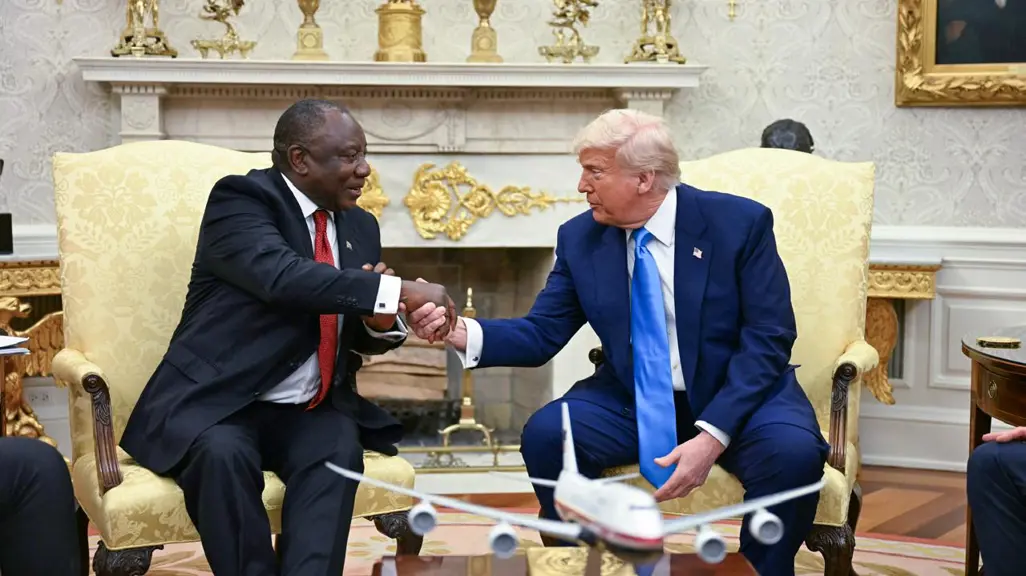
“President Cyril Ramaphosa met U.S. Ambassador Leo Brent Bozell III in Tshwane on 27 August 2026 to strengthen and recalibrate South Africa–U.S. relations. The meeting comes after years of diplomatic strain marked by aid suspensions, expulsions, and accusations of “white genocide” by Washington.”
South Africa’s international relations under politics have taken a pivotal turn this week as President Cyril Ramaphosa hosted U.S. Ambassador Leo Brent Bozell III at Mahlamba Ndlopfu, his official residence in Tshwane. The meeting, held on 27 August 2026, was framed as an effort to “recalibrate” ties between Pretoria and Washington, signaling a possible thaw in relations that have been strained throughout President Donald Trump’s second term.
Background of Strained Relations
Relations between South Africa and the United States have deteriorated sharply since 2025. Key flashpoints included:
- Suspension of U.S. aid to South Africa by executive order.
- Expulsion of Ambassador Ebrahim Rasool from Washington, declared persona non grata.
- Accusations of “white genocide” against Afrikaners, strongly rejected by Pretoria.
- U.S. abstention from G20 activities hosted by South Africa in 2025.
These developments created a diplomatic vacuum, with South Africa lacking an ambassador in Washington since Rasool’s expulsion.
Ambassador Bozell’s Role
Leo Brent Bozell III, nominated in March 2025, quickly became a controversial figure. His outspoken criticism of South Africa’s domestic and foreign policies, including remarks on investor perceptions and the “Kill the Boer” chant, drew rebukes from Pretoria. He was even issued a démarche order for overstepping diplomatic norms.
Ramaphosa’s Strategy
Ramaphosa’s decision to host Bozell reflects a pragmatic approach:
- Reaffirming constructive engagement on mutual interests.
- Seeking economic stability by reassuring investors of South Africa’s commitment to international cooperation.
- Balancing domestic politics with the need to maintain ties with Washington, a critical global power.
Implications for South Africa
The recalibration effort carries significant implications:
- Economic Relations: U.S. aid suspension has hurt development projects; restoring dialogue could unlock funding.
- Diplomatic Standing: South Africa’s credibility in multilateral forums like the G20 depends on stable U.S. ties.
- Domestic Politics: Ramaphosa must manage nationalist sentiment while engaging with a U.S. administration critical of ANC policies.
U.S. Perspective
For Washington, recalibrating ties with Pretoria is equally strategic:
- Regional Influence: South Africa remains a gateway to Africa’s markets and diplomacy.
- Security Concerns: Cooperation on counterterrorism and regional stability is vital.
- Political Optics: Trump’s administration seeks to balance criticism of ANC governance with pragmatic engagement.
Challenges Ahead
Despite the meeting’s positive tone, challenges remain:
- Trust Deficit: Years of hostile rhetoric have eroded goodwill.
- Policy Divergence: Pretoria’s positions on global issues, including Palestine and BRICS alignment, often clash with Washington’s.
- Ambassador’s Conduct: Bozell’s outspoken style may continue to generate friction.
Conclusion
The Ramaphosa–Bozell meeting marks a cautious but significant step toward repairing South Africa–U.S. relations. While deep-seated tensions remain, the willingness to engage constructively offers hope for a more stable diplomatic future. For South Africa, recalibrating ties with Washington is not just about politics—it is about securing economic resilience, international credibility, and strategic partnerships in a volatile global landscape.



