




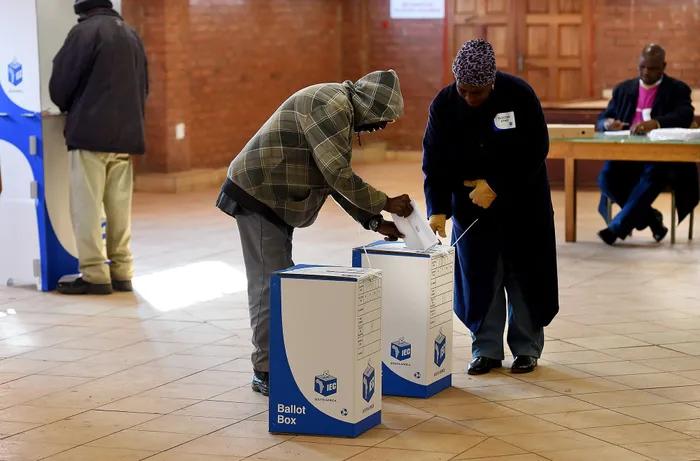
“Recent polling and voter-participation research point to significant changes in how different groups of South Africans view political leaders and the country’s democratic institutions ahead of the 4 November 2026 local government elections. Recent findings also show that public opinion varies considerably by age, party support and political engagement, while the IEC has warned that declining trust and public scepticism are important features of the current electoral environment.”
Public Opinion Takes Centre Stage Ahead of South Africa’s 2026 Local Elections
Public opinion is becoming an increasingly important feature of South Africa’s political landscape as political parties prepare for the November 2026 local government elections. With voters due to participate in municipal elections on 4 November, recent polling has highlighted changing attitudes towards political leaders, parties, government performance and democratic institutions. The findings provide a snapshot of voter sentiment, although they should not be treated as predictions of the election result.
One of the latest public-opinion reports was published on 25 September by The Common Sense, drawing on polling conducted with the Social Research Foundation. The report examined attitudes among South African voters aged over 65 and reported changes in favourable and unfavourable views of President Cyril Ramaphosa between March and July 2026.
According to the report, favourable views of Ramaphosa among voters aged over 65 had fallen by about half between the two survey waves. The publication said older voters had been his strongest age group in March but were his weakest group in July. At the national level, the change in Ramaphosa’s favourability was described as considerably smaller than the movement among the oldest respondents.
A separate report published on the same day examined retired voters and compared their views of Ramaphosa, former president Jacob Zuma and EFF leader Julius Malema. It reported that favourable views of Ramaphosa among retired voters had declined by more than 20 percentage points since March, while favourable views of Zuma had increased from a low base. The same report stressed that a clear majority of retired voters still viewed Zuma unfavourably.
These findings are significant because they demonstrate how political attitudes can differ between demographic groups. National polling figures can sometimes conceal substantial differences between age groups, regions, income categories and party supporters. For that reason, public-opinion research is generally more informative when the methodology, sample and timing of the survey are considered alongside the headline figures.
The polling behind the September reports was conducted between 8 and 31 July 2026 among 2,214 registered voters through telephone interviews. The researchers said the sample was weighted to reflect the registered-voter population across demographic characteristics. The national margin of error was reported as 2.1 percentage points at a 95% confidence level.
Because the fieldwork took place in July, the findings do not necessarily capture political developments that occurred during August and September. This distinction is particularly important during an election campaign, when public attitudes can change in response to debates, campaign events, policy announcements, controversies, economic developments and local issues.
Other polling released during September has also highlighted changing voter preferences. An Ipsos survey reported by Eyewitness News found significant differences in voting intentions across South Africa’s major metropolitan areas. The survey was conducted between June and July, with 3,600 randomly selected South Africans interviewed in their homes and in their preferred languages.
The Ipsos findings showed different levels of support across metropolitan municipalities. In Buffalo City, for example, the survey reported voting intentions of 29% for the ANC and 33% for the DA. In Nelson Mandela Bay, the ANC and DA were both recorded at 37%. The figures were described as voting intentions rather than actual election results.
At provincial level, the same survey reported the ANC at 31%, the DA at 25%, MK Party at 14% and EFF at 11%. The survey also recorded differences in stated likelihood of voting. Across the full sample, 33% said they were “very likely” to vote and another 43% said they were “likely” to participate.
These figures matter because voter participation is itself a central component of public opinion. A political party’s level of support among people who participate in a survey is not necessarily equivalent to its support among people who will ultimately cast a ballot. Turnout can change the composition of the electorate, especially in local elections where participation has historically been lower than in national elections.
The issue of political participation has also been highlighted by the Human Sciences Research Council. Earlier in 2026, HSRC research reported significant levels of disengagement and declining trust in political leadership. SABC News reported that nearly half of eligible South Africans were not registered to vote at the time of the research, while the study found that many citizens felt disconnected from political leaders and insufficiently heard by government.
The Electoral Commission has subsequently placed public trust and responsible political campaigning among the important issues surrounding the 2026 elections. At the September 23 signing of the Electoral Code of Conduct, IEC chairperson Mosotho Moepya referred to declining democratic trust, institutional disillusionment and public scepticism. Political parties participating in the election signed the code and committed themselves to campaigning within its rules.
The concerns around public trust are therefore broader than the popularity of any single political leader. They concern how citizens view democracy itself, whether political institutions respond to public needs and whether voters believe their participation can influence local governance.
For local government elections, these questions are particularly relevant because municipal authorities directly affect many aspects of daily life. Water services, sanitation, roads, electricity administration, waste collection, housing administration and other municipal functions can shape residents’ perceptions of government. Consequently, public opinion about local government can be influenced by practical experiences in communities rather than national political debates alone.
The 2026 election campaign is taking place against this backdrop of changing voter attitudes. Political parties are presenting competing programmes and seeking to persuade citizens that their candidates can address local problems. At the same time, voters are being exposed to campaign messages, political debates and competing claims about municipal performance.
The Electoral Code of Conduct signing also underlined the importance of voters being able to receive competing political messages without intimidation, violence or deliberate misinformation. Business Day reported that party leaders from several political organisations pledged to campaign peacefully and respect the electoral process.
Public opinion research should therefore be read as one source of information rather than as a substitute for the electoral process. Polls measure attitudes at a particular moment, using particular questions and samples. They can identify trends, but they cannot establish what voters will ultimately do on election day.
The timing of surveys is especially important in 2026. Several widely discussed surveys were conducted months before the November election. Since then, parties have launched campaigns, released manifestos and responded to political developments. The final weeks of campaigning could therefore generate additional information about voter priorities and participation.
Recent public-opinion findings nevertheless provide useful evidence about the political environment. They show that attitudes towards leaders are not uniform across age groups and that voter sentiment can change substantially over time. They also demonstrate that perceptions of government performance and political leadership can differ between supporters of different parties.
The broader question for South Africa is how these attitudes translate into participation in local democracy. A voter who is dissatisfied with government may choose to support an alternative party, abstain from voting, or become more politically active. Similarly, a voter who believes conditions are improving may become more willing to participate. Polling alone cannot determine which response an individual will choose.
As November 4 approaches, public opinion will therefore remain an important part of the political story. The available evidence points to a politically fluid environment in which different groups hold different assessments of leaders, parties and government performance.
For citizens, the most direct measure of political participation remains the election itself. Until ballots are cast and counted, polling figures remain measurements of opinion at specific points in time rather than final outcomes. The current evidence instead offers a picture of a South African electorate entering the local-government campaign with varying levels of confidence, political engagement and trust.
The public-opinion debate consequently extends beyond which party receives support. It also concerns whether citizens feel represented, whether institutions respond to their concerns and whether democratic participation remains meaningful in their communities. Those questions will continue to shape political discussion as South Africa moves towards the November local government elections



