




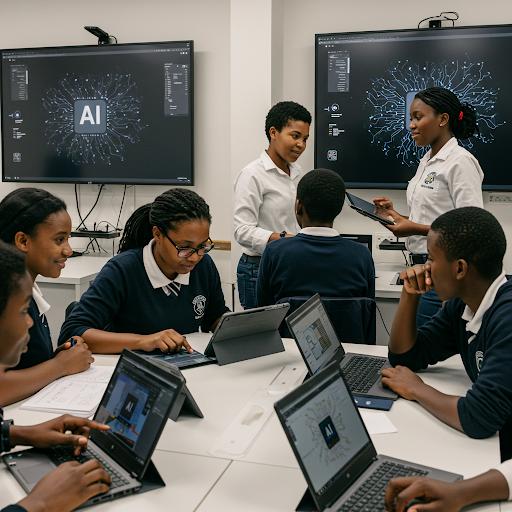
“South African school principals are rethinking homework and take-home assessments as growing numbers of learners use artificial intelligence tools to generate answers, sometimes without understanding the underlying work. The debate, raised at the South African Principals’ Association conference in Polokwane, is increasingly shifting from whether schools should allow AI to how teachers can redesign assessments, train educators and establish clearer rules for responsible use.”
Principals Wrestle With Homework in the AI Era as South African Schools Seek New Assessment Rules
Artificial intelligence is rapidly changing one of the most familiar parts of school life in South Africa: homework.
For decades, homework has provided teachers with a relatively straightforward way of checking whether learners understood classroom lessons, practising new concepts and preparing for examinations. But the widespread availability of generative AI tools has complicated that relationship. A learner can now enter a question into an AI system and receive an apparently complete answer within seconds, creating a new challenge for teachers who must determine whether the learner understands the response or simply submitted material produced by a machine.
That challenge was at the centre of discussions at the South African Principals’ Association conference in Polokwane, where school leaders considered the future of education under the theme “Future Ready”. Principals raised concerns that some learners are using AI to complete assignments without being able to explain the answers afterwards.
The issue illustrates a broader transformation taking place across South African education. AI is no longer a distant technology that schools can simply decide to address sometime in the future. Learners and teachers are already encountering generative AI in everyday educational activities, while policymakers are still working on appropriate national frameworks.
Homework Under Pressure
One of the central concerns raised by school leaders is that high marks on homework may no longer necessarily demonstrate genuine understanding.
Richard Olsin, principal of Witbank High in Mpumalanga, told the conference that traditional homework could no longer be treated as a reliable measure of a learner’s ability in the same way as before. He described situations in which learners could achieve very high homework scores but subsequently struggle to perform at the expected level in examinations.
A similar concern was raised by Stephen Sedikane, principal of Sensako Primary School in North West. According to the report, learners as young as Grade 4 are using AI for take-home activities and may subsequently struggle to explain the answers they submit.
That distinction is important because the educational value of an assignment is not simply the final answer. Homework can also be intended to develop research skills, reasoning, writing, problem-solving, memory and independent thinking.
If an AI system completes most of those cognitive steps, the learner may receive a correct-looking response without necessarily developing the skills the assignment was designed to teach.
The challenge therefore extends beyond detecting AI-generated work. It raises a fundamental question about what schools are actually measuring when they assign homework.
Schools Are Being Asked to Redesign Assignments
The response discussed by education leaders is not simply to eliminate homework.
Mashudu Ramulumo, president of the South African Principals’ Association, argued that schools should reconsider how assignments are designed rather than abandon homework because of AI. The emphasis, according to the TimesLIVE report, should be on tasks that require learners to apply knowledge, follow specific instructions and demonstrate their understanding.
This approach changes the teacher’s role from simply asking for an answer to designing assignments in which the learner’s reasoning is visible.
For example, instead of asking a learner to produce a generic research essay, a teacher could require the learner to compare sources, explain a personal interpretation, document the research process, discuss a local example or defend conclusions orally in class.
Such assignments do not necessarily prevent AI use. Instead, they make it more difficult for a learner to outsource the entire learning process to an automated system.
That distinction is becoming increasingly important as AI tools become better at producing fluent essays, explanations, summaries, calculations, presentations and other educational materials.
The Teacher Still Has a Central Role
The conference discussion also highlighted the need for teachers themselves to understand AI.
Ramulumo said educators and principals require training because some learners may have greater familiarity with digital tools than their teachers.
This creates a potential gap inside classrooms. A school can establish rules about AI, but teachers need sufficient knowledge to understand what different systems can do, how AI-generated content can be inaccurate and how learners may be using these tools.
The South African Department of Basic Education has already acknowledged the importance of responsible AI and digital citizenship. At the national Safer Internet Day 2026 event, the department participated in discussions focused specifically on safe and responsible use of AI, bringing together learners, teachers, government representatives and other stakeholders.
The department’s involvement indicates that the conversation extends beyond homework. Questions of online safety, privacy, responsible technology use and digital citizenship are increasingly connected to the development of AI literacy.
AI Can Also Be Used as a Learning Resource
The debate is not necessarily about treating artificial intelligence as inherently harmful to education.
South African educators are also exploring ways AI can support learning when used appropriately.
A recent report from the Citizen’s North Coast Courier described teachers at Reddam House Ballito adapting assignments in response to generative AI. One teacher said research tasks were increasingly being redesigned to include personal opinions, source analysis, application of knowledge and creative elements requiring individual thought.
The same report described situations in which AI could be used as a study partner rather than simply as an answer generator. In that role, an AI tool might explain a difficult concept, generate practice questions or help a learner identify gaps in understanding.
This distinction between using AI to learn and using AI instead of learning is likely to become increasingly important.
A learner who asks an AI system to explain a mathematical concept and then works through problems independently is engaging with the technology differently from a learner who asks the system to complete an assignment and submits the response without reviewing it.
Assessment May Move Back Into the Classroom
Another response discussed at the principals’ conference was greater emphasis on assessing learners directly in class.
Never Nthane, the association’s Mpumalanga convener, suggested that teachers could devote significant classroom time to checking whether learners actually understand the material before sending them home with assignments.
The idea reflects a broader educational adjustment: when take-home work becomes easier to outsource, classroom interaction becomes more important as a way of observing reasoning.
Teachers can ask learners to explain how they reached an answer, challenge an argument, identify an error or demonstrate a practical skill. Those activities provide information that a completed homework page may no longer provide reliably.
Prof Mamokgethi Phakeng, speaking in a keynote address, similarly argued that schools should recognise that learners have access to AI and design assessments accordingly. The principle reported by TimesLIVE was that if a task can be completely outsourced to AI within seconds, educators may need to reconsider what that task is measuring.
South Africa Still Needs Clearer National Guidance
The classroom debate is unfolding while South Africa works through wider questions about AI policy.
Basic Education Minister Siviwe Gwarube said the department was reviewing the country’s white paper on e-education, a framework that predates the current generation of generative AI technologies. According to the TimesLIVE report, Gwarube emphasised that machines may assist, but teachers should retain decision-making authority and learners should continue to think independently.
Education strategist Shirley Eadie has also called for clearer rules explaining when and how learners may use AI for particular assignments. Her argument is that schools need practical guidance rather than vague instructions, particularly because different assignments may have different expectations.
Her concern also extends to inequality. South African schools operate under very different conditions, with significant differences in connectivity, access to devices and teacher capacity.
A national AI policy that assumes every school has reliable internet, modern computers and teachers trained in AI could therefore create difficulties for schools with fewer resources.
The National AI Policy Debate Adds Another Layer
The uncertainty in schools is taking place alongside South Africa’s wider national AI policy process.
In April 2026, Communications and Digital Technologies Minister Solly Malatsi announced the withdrawal of the draft National Artificial Intelligence Policy after officials confirmed that the document contained fictitious sources in its reference list. The minister said the problem compromised the integrity and credibility of the draft.
The episode demonstrates why AI governance requires careful verification and human oversight, particularly when government policy itself is involved.
South Africa’s experience also underlines the importance of distinguishing between AI as a tool and AI as an authority. AI systems can generate useful material, but their outputs still require human evaluation.
International Experience Offers Different Models
South Africa is not alone in confronting questions about AI and education.
International education systems are experimenting with different responses, ranging from restrictions on certain AI tools to structured integration into classroom activities. The TimesLIVE report notes that New York City has announced a one-year ban on 40 AI tools in public elementary and middle schools for the 2026/27 school year, while Sweden has been promoting greater use of books and pen-and-paper amid concerns about excessive digitisation.
There is therefore no single international model.
UNESCO’s guidance on generative AI in education recommends a human-centred approach, with attention to data privacy, age-appropriate use, ethical considerations, teacher capacity and meaningful educational applications. The organisation also notes that technological development has been moving faster than the adaptation of many national regulatory frameworks.
For South Africa, these considerations are particularly relevant because the education system must balance innovation with unequal access to technology.
What Happens Next?
The immediate question for South African schools is unlikely to be whether AI can be stopped completely.
Instead, educators are increasingly confronting questions about where AI is useful, where it undermines learning, what information learners should be permitted to submit to AI systems, how teachers should assess AI-assisted work and how schools can protect learners’ personal information.
The discussion at the South African Principals’ Association conference suggests that homework itself may not disappear. Rather, the form of homework may change.
Assignments that require memorising information or producing generic written responses are increasingly vulnerable to automation. Tasks involving personal reflection, practical application, source evaluation, classroom discussion, problem-solving and explanation may become more important.
Teacher training will also be central. Educators need to understand both the possibilities and limitations of AI so they can guide learners effectively rather than simply attempt to police technology they do not fully understand.
For learners, meanwhile, AI literacy may become as important as traditional digital literacy. Knowing how to ask a question of an AI system is only one skill. Learners also need to know how to check an answer, identify errors, recognise fabricated information, protect personal data and determine when human expertise is necessary.
South Africa’s AI-in-education debate is therefore becoming much larger than the question of homework.
It is a debate about what schools should teach in a world where machines can increasingly generate answers — and about how education can ensure that learners still develop the ability to understand, question, analyse and create those answers for themselves.



