




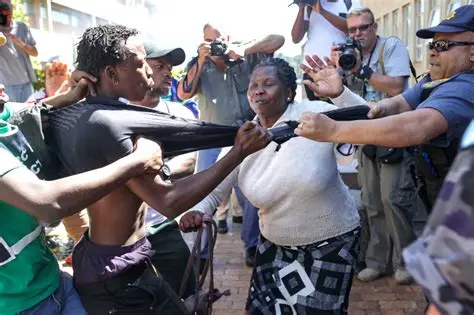
“Violent anti-immigrant protests in Johannesburg and other regions have escalated, with activists demanding undocumented migrants leave South Africa, leading to mass displacement and at least four deaths. Civil society groups warn that the movement, while framed as activism, has devolved into xenophobic violence undermining social cohesion and human rights.”
South Africa is once again at the center of a heated political and social debate as activism against undocumented migration has transformed into violent demonstrations, displacing tens of thousands of foreign nationals. What began as organized marches and ultimatums by grassroots movements has spiraled into widespread xenophobic attacks, raising urgent questions about the intersection of activism, politics, and human rights.
Background
Since March 2026, activist groups such as the March and March movement and Operation Dudula have mobilized communities under the banner of reclaiming jobs and housing from undocumented migrants. These groups issued a June 30 ultimatum, demanding all undocumented migrants leave South Africa or face consequences. Despite government statements emphasizing that only the state has authority over immigration enforcement, activists pressed forward, staging rallies and raids.
Escalation of Violence
- Robberies and assaults: In Thembelihle, Johannesburg, Malawian residents reported armed gangs breaking into homes, beating occupants, and ordering them to “go home.”
- Mass displacement: More than 160,000 migrants from Mozambique, Nigeria, Zimbabwe, and Malawi have fled South Africa since March, with 54,000 deported.
- Fatalities: At least four migrants have been killed, while many others sought refuge in churches, embassies, and temporary shelters.
Activism vs. Xenophobia
While organizers describe their actions as activism for economic justice, critics argue that the movement has devolved into xenophobic vigilantism. Activists claim they are defending South African workers from unfair competition, but human rights groups highlight that migrants often fill labor gaps in construction, domestic work, and informal trade.
Government Response
The South African government has struggled to balance public frustration over unemployment with constitutional protections for migrants. Officials have condemned vigilante violence but admitted that immigration data remains incomplete, complicating enforcement. Police presence at marches has been criticized as passive, with officers accused of watching as migrants were evicted from homes.
Civil Society and Human Rights
Civil society organizations, including the Institute for Security Studies (ISS) and church groups, have documented harassment, evictions, and destruction of livelihoods. They argue that activism rooted in exclusion undermines South Africa’s democratic values and risks destabilizing communities already burdened by poverty and inequality.
Historical Context
South Africa’s history of migration is complex:
- Post-1994 democracy: Nelson Mandela welcomed migrants from across Africa, framing South Africa as a beacon of solidarity.
- Economic pressures: Rising unemployment and inequality have fueled resentment, with migrants scapegoated for systemic failures.
- Recurring violence: Xenophobic attacks have erupted periodically since the early 2000s, often coinciding with economic downturns.
Voices from the Ground
Migrants recount harrowing experiences:
- Eibraheem Hussein, a Malawian resident since 2000, was beaten and robbed in his home.
- Families displaced from Gauteng and KwaZulu-Natal describe sleeping outdoors in winter conditions after being evicted.
Broader Implications
The protests highlight critical issues:
- Economic inequality: Activists argue migrants worsen unemployment, but economists note structural issues in South Africa’s labor market.
- Regional relations: Neighboring countries, whose citizens are targeted, may reassess diplomatic ties.
- Democratic values: The tension between activism and xenophobia tests South Africa’s commitment to human rights.
Conclusion
South Africa’s latest wave of activism under the banner of anti-immigration has exposed deep fractures in society. While activists frame their actions as a fight for economic justice, the violence and displacement reveal a darker reality of xenophobia and exclusion. The challenge for South Africa lies in addressing legitimate grievances about inequality without sacrificing its democratic principles or human rights obligations.



