




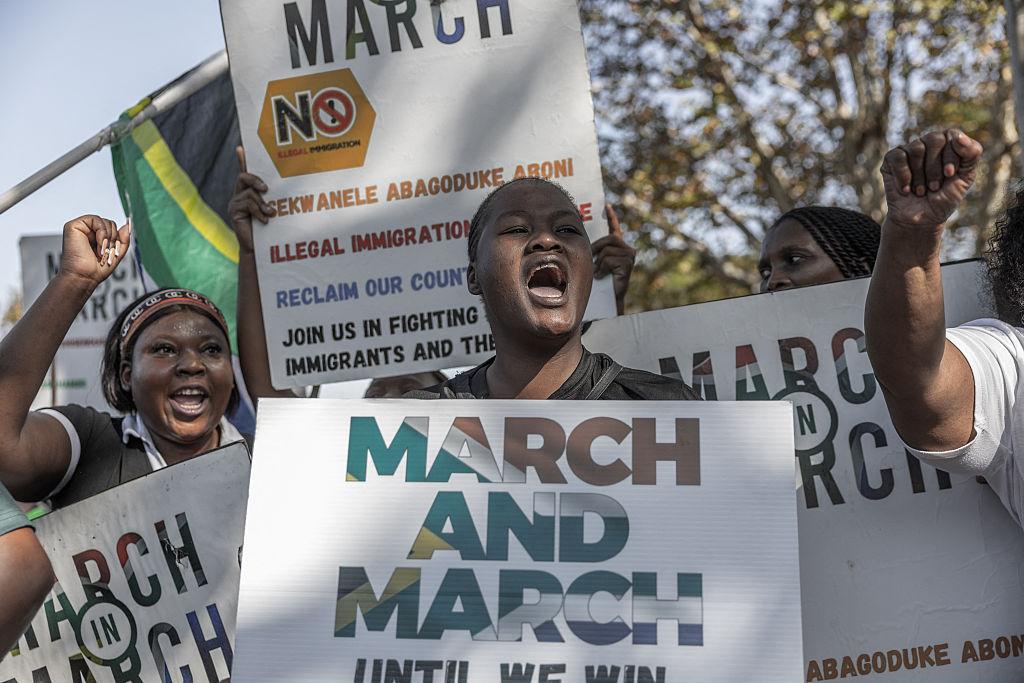
“South Africa’s anti-immigration movement March and March has intensified its confrontation with government authorities over immigration enforcement, refugee reception centres and restrictions on demonstrations, making activism and protest rights major political issues around the country’s local government elections. Court restrictions, police intervention and military deployments in KwaZulu-Natal have heightened tensions, while the movement’s leaders argue that government is suppressing citizens’ demands.”
South Africa’s March and March Movement Faces Government as Activism, Immigration and Protest Rights Dominate Political Debate
Introduction
South Africa’s political activism landscape has entered a period of heightened tension following increasingly confrontational demonstrations by the March and March movement, a citizens’ organisation campaigning for stricter immigration enforcement and greater protection of South African employment opportunities. The movement’s activities have become a major political issue, particularly in KwaZulu-Natal, where protests, court proceedings, police operations and public debates over immigration have intensified.
The developments have placed the government under pressure to balance constitutional protections for peaceful demonstrations with its responsibility to maintain public order and protect vulnerable communities. Meanwhile, activists, civil society organisations, political parties and affected foreign nationals have raised competing arguments concerning immigration enforcement, public services, employment, human rights and the boundaries of political mobilisation.
As South Africa moves beyond its 4 November 2026 local government elections, the confrontation between March and March and state authorities illustrates how grassroots activism can influence political debate, public policy and electoral conversations.
March and March’s growing political influence
March and March emerged as a visible grassroots movement in 2024, developing from community concerns about immigration enforcement, employment competition and access to public services. Its campaign has subsequently expanded into broader criticism of government performance, policing, economic opportunities and administrative accountability.
The movement has organised demonstrations, submitted memoranda to government institutions and mobilised supporters around immigration-related grievances. Its leaders argue that government institutions have failed to respond adequately to concerns about undocumented immigration and the consequences for local communities.
The organisation’s campaign has attracted significant attention because it connects immigration debates with South Africa’s persistent unemployment, poverty and dissatisfaction with public services.
However, the movement’s political influence has also generated controversy. Critics accuse anti-immigration activists of using legitimate economic and social concerns to promote hostility towards foreign nationals. Human rights organisations have raised concerns about intimidation, discrimination and violence against migrants.
The competing interpretations have made March and March a prominent example of how activism can simultaneously influence public policy discussions and generate serious constitutional and human-rights concerns.
Government and the courts respond to demonstrations
The confrontation between March and March and government authorities intensified during October 2026, particularly around the Durban Home Affairs Refugee Reception Centre.
Authorities sought judicial restrictions on demonstrations amid concerns about violence, intimidation, obstruction of roads and threats to businesses and public facilities.
The Durban High Court subsequently allowed demonstrations to continue under strict conditions rather than imposing an unrestricted prohibition.
The court’s restrictions included requirements that demonstrations remain peaceful and that participants refrain from violence, intimidation, looting, property damage and the possession of weapons. Restrictions also addressed face coverings and conduct that could prevent identification.
According to reporting by SABC News and IOL, the movement remained permitted to protest, but it was required to comply with conditions intended to protect public safety and electoral processes.
The legal developments are important because they demonstrate that South African constitutional protections for protest do not eliminate restrictions against unlawful conduct.
Peaceful demonstrations remain a recognised democratic mechanism, while violence, intimidation and obstruction can attract legal consequences.
Immigration enforcement becomes a national political issue
The protests have also drawn attention to the relationship between immigration administration and constitutional protections.
A Constitutional Court ruling concerning access to asylum procedures became a significant point of controversy after its implications were widely debated.
Government officials explained that the judgment did not automatically grant refugee status or permanent residence to undocumented foreign nationals. Instead, it addressed procedural barriers affecting access to asylum applications.
Nevertheless, the ruling generated substantial public disagreement and contributed to demonstrations in Johannesburg and Durban.
Reuters reporting carried by Devdiscourse documented violent incidents during October, including burning vehicles and looting in affected areas.
Authorities blamed misinformation surrounding the asylum ruling for contributing to unrest. They warned that inaccurate claims about immigration procedures could inflame community tensions and undermine public confidence in government institutions.
The controversy illustrates the importance of accurate information during politically sensitive demonstrations.
Immigration enforcement remains a legitimate subject of public debate, but claims about migrants, crime, employment and public services require reliable evidence rather than assumptions or generalisations.
Public order and military deployment
The scale of tensions in KwaZulu-Natal prompted additional security measures.
Police increased operational resources, while President Cyril Ramaphosa authorised the deployment of approximately 510 South African National Defence Force members to support policing operations in the province.
The deployment was intended to assist authorities in maintaining public order and responding to security threats associated with unrest.
However, the military presence also became a subject of political criticism.
Movement leaders questioned why soldiers were deployed during demonstrations while communities continued to experience unemployment, crime and service delivery problems.
Government authorities maintained that the intervention was intended to support law enforcement rather than suppress lawful political participation.
The disagreement highlights a central challenge in democratic governance: security measures must protect citizens without unnecessarily restricting constitutional freedoms.
Activism and the right to protest
South Africa’s constitutional framework protects freedom of expression, assembly and association.
These rights allow citizens to organise demonstrations, communicate grievances, demand accountability and challenge government decisions.
Nevertheless, the exercise of these freedoms carries responsibilities.
Protest organisers must ensure that demonstrations do not become instruments of intimidation or violence. Authorities must also avoid treating peaceful political criticism as inherently unlawful.
The March and March dispute therefore raises questions extending beyond immigration.
It concerns the relationship between political mobilisation, state power, public safety and constitutional democracy.
Civil society organisations have repeatedly emphasised that peaceful protest should remain protected, while unlawful attacks against individuals or businesses must be investigated and prosecuted.
Critics raise concerns about xenophobia and human rights
Human rights activists and organisations have criticised the movement’s anti-immigration messaging, particularly where demonstrations have allegedly involved threats against foreign nationals or migrant-owned businesses.
GroundUp reported criticism from activists who argued that immigration campaigns have sometimes appropriated legitimate concerns about gender-based violence, unemployment and crime to advance xenophobic narratives.
The publication also documented incidents involving alleged assaults, intimidation and threats during demonstrations.
Critics argue that migrants should not be collectively blamed for crime or economic difficulties.
They maintain that South Africa’s unemployment, poverty and public service challenges are rooted in complex structural problems requiring effective government policies, economic reform and institutional accountability.
The debate has consequently become a contest between competing political narratives.
Movement supporters emphasise border enforcement and citizens’ economic concerns, while opponents highlight constitutional rights, social cohesion and the protection of vulnerable communities.
Both immigration administration and the protection of human rights remain important responsibilities for the state.
Local elections and political mobilisation
The movement’s activities unfolded during the campaign period for South Africa’s 2026 local government elections.
Immigration, public safety, employment, service delivery and government accountability became increasingly prominent issues in political conversations.
The elections also provided an opportunity for civic organisations to reconsider their relationship with established political parties.
Some community and ratepayer organisations have pursued electoral participation after years of demonstrations and campaigns against municipal authorities.
The National reporting published in October described civic movements seeking council representation rather than relying exclusively on protest.
This development illustrates a broader transformation in South African activism.
Community organisations increasingly recognise that political influence can be pursued through demonstrations, petitions, litigation, electoral participation and direct engagement with public institutions.
The relationship between activism and electoral politics is therefore becoming more complex.
Social media and the amplification of activism
Digital platforms have played an important role in extending the reach of political activism.
Campaign messages, protest footage, public statements and political commentary circulate rapidly across social media.
The Daily Maverick’s political analysis published on 2 November examined the growing prominence of anti-foreigner political communities in online conversations ahead of the elections.
The analysis found substantial political discussion surrounding March and March, immigration, government responses and opposition narratives.
However, social media amplification also creates challenges.
Unverified information can spread rapidly, particularly when political content appeals to fear, anger or economic frustration.
Digital platforms can strengthen civic participation, but they can also amplify misinformation, harassment and inflammatory rhetoric.
Responsible reporting and public communication are therefore essential in maintaining informed political debate.
The economic grievances behind activism
The movement’s campaign cannot be understood independently of South Africa’s wider economic conditions.
Unemployment, inequality, crime and weak public services remain major sources of dissatisfaction.
Communities experiencing economic insecurity may become increasingly frustrated when they believe government institutions are failing to enforce regulations or provide opportunities.
These frustrations can motivate demonstrations and demands for political accountability.
However, economic grievances do not automatically justify discriminatory treatment of migrants.
The challenge facing policymakers is to address employment creation, skills development, business regulation, immigration administration and municipal service delivery without encouraging hostility between communities.
Effective responses require transparent enforcement, reliable data, economic development and cooperation between government institutions and civil society.
What happens next?
The movement’s confrontation with authorities is likely to remain politically significant beyond the election period.
March and March leaders have indicated that demonstrations will continue under applicable court conditions, while authorities remain responsible for protecting public order.
The movement and government are expected to continue engaging through legal processes, political communication and public demonstrations.
The dispute also raises broader questions about how South Africa manages immigration, protects peaceful protest and responds to community dissatisfaction.
For government institutions, the challenge is to demonstrate that immigration laws are administered effectively while constitutional protections remain respected.
For activists, the challenge is to communicate grievances responsibly and ensure that mobilisation does not undermine the rights or safety of other communities.
For civil society, the continuing task is to promote accurate information, accountability and peaceful participation.
Conclusion
South Africa’s March and March controversy demonstrates the growing importance of activism in national political conversations.
The movement has succeeded in placing immigration enforcement, employment concerns and government accountability prominently on the public agenda.
At the same time, its activities have raised difficult questions concerning xenophobia, public safety, constitutional rights and the responsibilities of protest organisers.
The government’s response, including court proceedings and security deployments, reflects the complexity of balancing peaceful political participation with the protection of communities and institutions.
Ultimately, the developments underline a fundamental principle of democratic governance: citizens must be able to express grievances and challenge government decisions, while every individual remains entitled to dignity, safety and equal protection under the law.
As South Africa moves beyond its local elections, the future of political activism will depend not only on the strength of public mobilisation but also on the ability of political leaders, civil society and government institutions to address grievances constructively, protect constitutional freedoms and prevent violence.



