




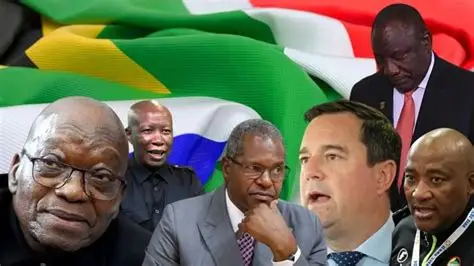
“The Democratic Alliance faces internal turmoil after leader Geordin Hill-Lewis announced a reshuffle of Government of National Unity deployments, sparking backlash from senior members who fear weakened influence in governance. The revolt highlights deep fractures within South Africa’s coalition politics, threatening stability at a critical moment for national governance.”
South Africa’s political landscape has once again been thrust into turbulence as the Democratic Alliance (DA), a key player in the Government of National Unity (GNU), grapples with internal dissent. The controversy stems from DA leader Geordin Hill-Lewis’s decision to reshuffle the party’s deployments within the GNU, a move intended to strengthen governance efficiency but which has instead triggered an internal revolt. This development underscores the fragility of coalition politics in South Africa and raises pressing questions about the future of governance under the GNU framework.
Background: The GNU Context
The GNU was established as a broad coalition to stabilize South Africa’s governance amid mounting socio-economic challenges, including unemployment, corruption, and service delivery failures. The DA’s participation was seen as crucial in balancing the African National Congress (ANC)’s dominance. However, coalition politics inherently demand compromise, and the DA’s reshuffle has exposed the difficulty of maintaining unity within such arrangements.
The Reshuffle Decision
Hill-Lewis’s reshuffle aimed to reposition DA members in strategic governance roles, ostensibly to maximize the party’s impact on policy implementation. Key changes included reassignments in parliamentary committees and provincial deployments. While Hill-Lewis argued that the reshuffle was necessary to align with evolving governance priorities, critics within the DA accused him of sidelining experienced members and consolidating power around his allies.
Internal Revolt
Senior DA figures voiced strong opposition, warning that the reshuffle undermines the party’s credibility and weakens its influence within the GNU. Some members accused Hill-Lewis of acting unilaterally without adequate consultation, fueling perceptions of authoritarian leadership. The revolt has manifested in heated internal debates, resignations from certain committee positions, and calls for an urgent review of the reshuffle strategy.
Governance Implications
The DA’s internal divisions threaten to destabilize the GNU at a time when South Africa urgently needs cohesive governance. The revolt risks diminishing the DA’s negotiating power within the coalition, potentially allowing the ANC to consolidate control. Moreover, the turmoil could erode public confidence in the GNU’s ability to deliver on its promises of reform, transparency, and improved service delivery.
Public and Expert Reactions
Political analysts have described the DA’s revolt as symptomatic of broader challenges in coalition governance. Experts warn that unless the DA resolves its internal disputes, the GNU could face paralysis in decision-making. Civil society groups have expressed concern that political infighting distracts from urgent governance priorities, such as addressing unemployment and tackling corruption.
Historical Parallels
South Africa’s history of coalition politics offers sobering lessons. Previous attempts at unity governments have often faltered due to internal rivalries and competing agendas. The DA’s current crisis echoes these patterns, highlighting the difficulty of sustaining coalitions in a polarized political environment.
Potential Outcomes
Several scenarios could unfold:
- Reconciliation: Hill-Lewis may engage in dialogue with dissenting members, leading to a compromise that restores unity.
- Escalation: Continued resistance could result in resignations or defections, weakening the DA’s position in the GNU.
- Restructuring: The DA may be forced to reconsider its role in the GNU, potentially reshaping coalition dynamics.
Conclusion
The DA’s internal revolt over the GNU reshuffle is more than a party dispute—it is a governance crisis with national implications. As South Africa navigates complex socio-economic challenges, the stability of the GNU is paramount. Whether the DA can resolve its divisions will determine not only its own future but also the trajectory of governance in South Africa.



