




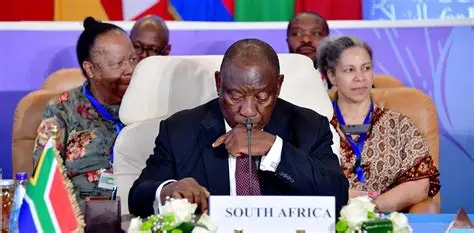
“President Cyril Ramaphosa strongly defended South Africa’s non-aligned foreign policy during a parliamentary session, stressing that Pretoria seeks peace and constructive relations with all nations. His remarks come amid heightened diplomatic tensions with Washington over South Africa’s ties with China, Russia, and Iran.”
South Africa’s foreign policy has once again become the subject of international debate as President Cyril Ramaphosa reaffirmed the country’s non-aligned stance in global affairs. Speaking before the National Council of Provinces, Ramaphosa emphasized that Pretoria’s approach is rooted in sovereignty, dialogue, and multilateral cooperation, even as criticism mounts from Washington regarding South Africa’s ties with China, Russia, and Iran. This development underscores the challenges of navigating an increasingly polarized global order, where middle powers like South Africa must balance diverse relationships without compromising national interests.
Background of the Tensions
The latest diplomatic friction stems from comments made by US Ambassador Leo Brent Bozell III, who criticized South Africa’s foreign policy on social media, particularly its deepening ties with Beijing and Tehran. Deputy President Paul Mashatile’s recent visit to Beijing further fueled speculation about Pretoria’s strategic leanings. Washington has also expressed concern over South Africa’s participation in joint military exercises with Russia and China, suggesting that Pretoria’s stance may undermine Western interests in Africa.
Ramaphosa’s Defense
Ramaphosa was unequivocal in his defense, stating: “We don’t see ourselves as a country of enemies. We are a country that seeks to be at peace with all other countries and have good relations with all.” He stressed that non-alignment does not equate to neutrality or disengagement, but rather reflects an independent foreign policy aimed at fostering dialogue and cooperation. According to Ramaphosa, this approach allows South Africa to engage constructively with diverse powers without compromising its sovereignty.
Principles of South Africa’s Foreign Policy
South Africa’s foreign policy is grounded in the Constitution and guided by principles of human rights, peace, and multilateralism. The government seeks to promote a rules-based international order, ensuring that engagements are based on mutual respect and non-interference. This framework enables Pretoria to pursue national interests while contributing to global stability. Ramaphosa reiterated that South Africa’s diplomatic engagements are not about choosing sides but about advancing dialogue and cooperation in a fragmented world.
Relations with the United States
Despite tensions, Ramaphosa emphasized the importance of South Africa’s long-standing relationship with the United States. Pretoria continues to value cooperation in areas such as trade, investment, and security. However, he cautioned against external pressures that seek to dictate South Africa’s foreign policy choices, insisting that sovereignty must remain paramount. This balancing act reflects Pretoria’s attempt to maintain constructive ties with Washington while deepening relations with emerging powers.
Strategic Engagements with China, Russia, and Iran
South Africa’s ties with China have grown significantly, particularly in trade, infrastructure, and energy cooperation. Beijing’s role as a key partner in Africa’s development agenda has made it an indispensable ally for Pretoria. Similarly, South Africa’s participation in BRICS has strengthened its ties with Russia, with joint military exercises symbolizing deeper strategic cooperation. Engagements with Iran, though controversial, reflect Pretoria’s commitment to dialogue with diverse actors in pursuit of global peace and economic opportunities.
Implications for Global Diplomacy
Ramaphosa’s reaffirmation of non-alignment highlights South Africa’s determination to remain an independent actor in global affairs. This stance positions Pretoria as a bridge-builder in international diplomacy, capable of engaging with both Western and non-Western powers. However, it also exposes South Africa to criticism from allies who expect greater alignment with their strategic interests. The challenge for Pretoria lies in maintaining credibility as a non-aligned actor while navigating the pressures of an increasingly polarized world.
Conclusion
South Africa’s non-aligned foreign policy reflects a deliberate choice to prioritize sovereignty, dialogue, and multilateralism in global affairs. President Ramaphosa’s defense of this approach underscores Pretoria’s determination to pursue independent engagement with diverse powers, even amid mounting criticism from Washington. As global tensions intensify, South Africa’s role as a non-aligned actor will remain central to its diplomatic identity, shaping its engagements in Africa and beyond.



