




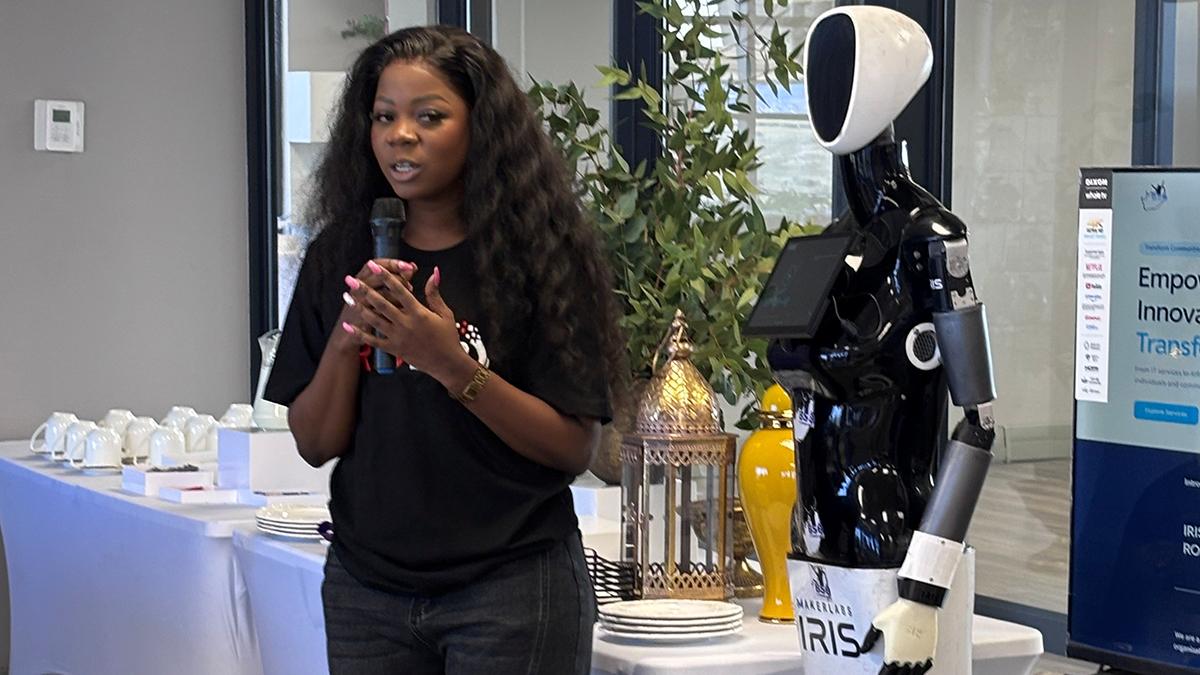
“South Africa’s Department of Science, Technology and Innovation has expressed support for the potential of IRIS AI-powered humanoid tutor robots to assist teachers, expand educational support and stimulate employment through technology-related activities. However, the initiative faces important questions about children’s personal information, overseas data transfers, manufacturing arrangements, public funding and whether the projected benefits can be demonstrated at scale.”
South Africa explores the role of robotics in education
South Africa’s growing interest in artificial intelligence and robotics has brought educational technology into the national conversation. The IRIS humanoid tutor initiative is one example of how automated systems could support teaching, provide additional learning assistance and create opportunities in the technology sector.
The initiative has also highlighted the need to balance technological ambition with practical questions about cost, accountability, child protection and long-term educational value.
In an article published by MyBroadband in October 2026, Science, Technology and Innovation Minister Blade Nzimande discussed the potential role of AI and robotics in inclusive development, youth skills development and job creation. His comments followed parliamentary questions about the IRIS robot tutors and their proposed expansion in South African schools.
The debate comes at a time when schools are under pressure to improve learning outcomes while dealing with uneven access to educational resources. Although robotics may offer additional support, its value will depend on how effectively the technology addresses actual classroom needs.
What is the IRIS robot tutor?
IRIS is an AI-powered educational robot associated with BSG and Technologies and innovator Thandoh Gumede. The initiative was publicly launched in 2025, and its subsequent development has focused on the possibility of using humanoid robot tutors to support education in South Africa.
According to reporting by the South African Broadcasting Corporation and the Department of Science, Technology and Innovation, the system is designed to assist learners across educational levels, from Grade R through tertiary education, with support for all 11 official South African languages.
Multilingual capability is particularly relevant in South Africa, where learners have different home languages and may face difficulties accessing educational material in a language they understand comfortably.
Nevertheless, a robot’s ability to communicate in several languages does not automatically establish the accuracy of its explanations, the suitability of its curriculum or its effectiveness in improving academic performance. These outcomes require independent evaluation.
Government support and the manufacturing ambitions
A significant development occurred in August 2026, when a manufacturing facility and showroom associated with IRIS were announced at Dube TradePort in Durban, KwaZulu-Natal.
The Department of Science, Technology and Innovation welcomed the initiative, presenting local manufacturing and the broader innovation ecosystem as potential sources of economic development, technical skills and employment.
The project has an ambitious stated goal: expanding access to the robot across South Africa’s approximately 23,000 public schools. Its proponents have also discussed the potential to create 20,000 jobs over five years through manufacturing, technical support, training and related activities. These figures represent ambitions rather than verified nationwide deployment or employment outcomes.
That distinction matters. Establishing a facility does not mean every school has received a robot, and a job-creation target does not establish how many permanent positions will ultimately be funded.
For the initiative to demonstrate its economic value, further information would be needed about production capacity, investment, procurement arrangements, training programmes and the actual number of jobs created.
Why schools may benefit from educational robotics
One of the strongest arguments for educational robotics is its potential to provide supplementary assistance to teachers and learners.
In a classroom where learners need different levels of explanation, an AI tutor could help reinforce a lesson, offer practice questions or explain a concept in alternative ways. It could also provide another opportunity for learners to engage with educational material outside direct teacher-led instruction.
Teachers could potentially use AI-assisted systems to reduce repetitive tasks and prepare supplementary learning activities. This would be particularly useful if the technology freed up time for activities that require professional judgement, individual attention and classroom management.
However, the intended role should remain clear. Educational robots should support teachers rather than be treated as automatic substitutes for qualified educators.
Effective teaching involves much more than delivering information. Teachers identify misunderstandings, recognise emotional and social needs, manage classroom dynamics and adapt instruction to individual circumstances. A robot may assist with selected tasks, but those wider responsibilities require human oversight.
Addressing inequality between schools
The potential impact of educational robotics also needs to be considered against South Africa’s unequal access to technology.
Some schools have reliable connectivity, suitable computer facilities and established technical support. Others face shortages of equipment, infrastructure constraints and competing demands on limited budgets.
Introducing humanoid robots could create new learning opportunities, but only if schools can afford and maintain the equipment and have the necessary infrastructure to use it effectively.
The total cost of deployment is therefore central to the discussion. A robot may require connectivity, compatible devices, software subscriptions, maintenance, repairs, staff training and ongoing technical support.
TechCentral’s August 2026 investigation highlighted the financial implications of deploying IRIS nationally and questioned the difference between the project’s public ambitions and its implementation to date. It reported that only five schools had received the robots at the time covered by its investigation, with the company providing the systems used at those schools.
This illustrates why a national rollout should be evaluated through confirmed installations and measured results, rather than targets alone.
A phased approach could help schools assess the technology before committing to large-scale expenditure. Pilot programmes should examine whether the robots improve learning, which learners benefit most and what support schools require to use them safely.
Children’s privacy is a central concern
One of the most significant issues surrounding AI tutor robots is the protection of children’s personal information.
Conversational systems may process voice recordings, questions, names and other information shared during interactions. Depending on their configuration, they may also retain conversation histories or transmit information to external services.
When these technologies are used in schools, data protection must be built into their design and deployment.
MyBroadband reported in October that legal and privacy concerns had been raised about the collection and processing of children’s information through IRIS. The reporting also highlighted questions about international transfers of personal data associated with the robots’ overseas manufacturing and technology arrangements.
South Africa’s Protection of Personal Information Act, commonly known as POPIA, provides an important framework for handling personal information. Children’s information receives additional protection under the legislation, and organisations must establish an appropriate lawful basis and satisfy the applicable requirements before collecting and processing it.
Schools and technology providers should clearly explain what information a robot collects, why it is needed, where it is stored, who can access it and how long it is retained.
Where required, appropriate parental or guardian consent must be obtained. Data protection impact assessments, access controls, security testing and transparent retention policies can help identify and reduce risks.
International data transfers also require careful assessment against the relevant provisions of POPIA. The location of a robot’s manufacturer alone does not establish where every item of information is processed; that requires examination of the actual technical and contractual arrangements.
The essential principle is that children should not have to surrender unnecessary personal information to receive educational support.
Who is responsible when an AI tutor makes a mistake?
Privacy is not the only concern. AI systems can produce inaccurate information, misunderstand a question or generate explanations that are unsuitable for a learner’s age or educational level.
These risks matter in classrooms because learners may assume that a robot presented as a tutor is authoritative.
Schools should therefore establish clear procedures for reviewing educational content and reporting errors. Teachers need the ability to intervene when a response is inaccurate, confusing or inappropriate.
The systems should also make their limitations clear. Learners should be encouraged to verify important information and ask teachers for clarification rather than accept every automated answer.
Independent evaluation should assess performance across different languages, subjects and age groups. It should also examine whether the system handles sensitive questions appropriately and whether its responses are consistent with the relevant curriculum.
Such safeguards are essential if AI tutoring is to complement established teaching practices rather than introduce new risks.
Can the project deliver 20,000 jobs?
The proposed employment benefits are another important part of the initiative.
Robotics can support employment in areas such as assembly, maintenance, software development, technical support, logistics and training. Local production may also create opportunities for suppliers and businesses that provide related services.
However, projected employment must be distinguished from verified jobs.
The 20,000-job figure associated with IRIS represents a stated target. The available reporting does not establish that these jobs have already been created or that the full target will be reached.
To assess the economic impact, the public needs information about the number of workers currently employed, the qualifications required, the training offered and the expected balance between permanent jobs and temporary or indirect opportunities.
There is also an important distinction between assembling imported equipment and developing locally owned intellectual property, software and manufacturing capabilities. Both activities can contribute economically, but they may produce different long-term benefits for domestic industry.
Transparent reporting would help policymakers determine whether public support is generating measurable employment, skills transfer and sustainable business growth.
The importance of responsible implementation
The IRIS initiative reflects a broader question facing South Africa: how can emerging technologies be introduced in ways that improve public services without creating unnecessary costs or risks?
A responsible rollout would start with clearly defined educational objectives. Schools should identify the problems they want the technology to address before deciding whether a humanoid robot is the most effective solution.
For example, if the priority is additional language practice, revision exercises or assistance with repetitive administrative tasks, decision-makers should compare the robot with other available digital tools. The best option would be the one that delivers reliable results at an appropriate cost.
Pilot programmes should measure outcomes before and after deployment. Useful indicators include learner engagement, subject performance, teacher workload, system reliability, maintenance costs and the frequency of inaccurate responses.
Evaluations should also include teachers, parents and learners. Their feedback can reveal whether the system is genuinely useful or whether the novelty of interacting with a robot fades after the initial introduction.
Procurement decisions should be transparent, with clear information about costs, contracts, software support and responsibility for failures. Long-term maintenance arrangements are especially important because schools cannot depend on equipment that becomes unusable when a supplier stops providing updates or spare parts.
The road ahead for robotics in South Africa
South Africa has opportunities to use robotics in education, healthcare, manufacturing, agriculture and other sectors. The challenge is to translate technological potential into reliable services that solve practical problems.
IRIS has brought these questions into focus because it combines educational ambitions with claims about manufacturing, employment and expanded access to learning support.
Its success will ultimately depend on evidence. Policymakers and schools will need to establish whether the robots improve learning outcomes, whether their costs are justified, whether children’s information is adequately protected and whether the employment benefits materialise.
The project also provides an opportunity to strengthen South Africa’s broader approach to responsible AI. Clear standards for privacy, transparency, curriculum alignment and independent assessment would help schools evaluate educational technology consistently.
Government support can encourage innovation, but it should not replace scrutiny. Promising projects need to demonstrate their value, and public commitments should be matched by verifiable progress.
For South African learners, the most important measure is not whether a robot looks advanced or can hold a conversation. It is whether the technology helps them learn more effectively, safely and equitably.
If those conditions are met, educational robotics could become a useful addition to the classroom. If they are not, ambitious rollout targets risk running ahead of the evidence needed to justify them.
The next stage of the IRIS story will therefore depend on implementation, independent assessment and transparent reporting—not simply on the promise of a robotic future.



