




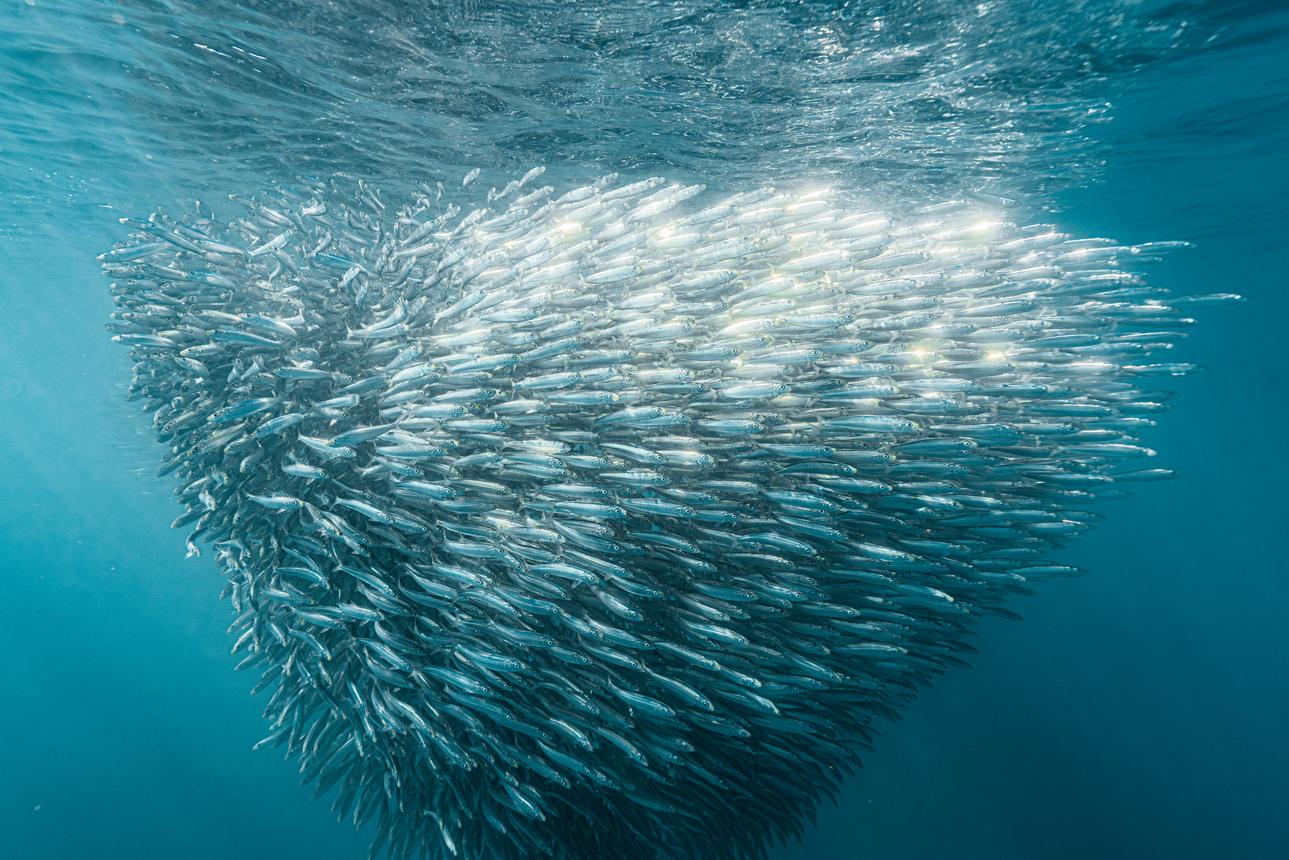
South Africa’s Department of Forestry, Fisheries and the Environment says laboratory testing has increasingly detected pilchard herpesvirus in affected or dead sardines compared with apparently healthy fish, strengthening the suspected link between the virus and the widespread mortality event reported from late July to early September 2026. Scientists are continuing diagnostic work and preparing an end-of-year hydroacoustic survey to estimate sardine abundance, distribution and size structure, while precautionary restrictions on directed sardine catches remain in force through 30 October.
South Africa’s sardine mortality investigation enters critical phase as scientists prepare major marine population survey
South Africa’s investigation into the widespread deaths of sardines along its coastline has entered an important scientific phase, with laboratory evidence increasingly associating the event with pilchard herpesvirus (PHV). Researchers are continuing to investigate the factors behind the mortality, while preparations for a major marine population survey are expected to provide essential information about the condition of the country’s sardine stocks.
The investigation is significant for marine conservation, fisheries management and environmental science. Sardines are an important component of the Benguela marine ecosystem, supporting commercial fishing activities and serving as prey for larger fish, seabirds and other marine predators. Understanding why thousands of fish died across multiple coastal areas is therefore important not only for determining the health of the sardine population but also for assessing possible consequences for the wider marine environment.
An environmental event that attracted national attention
The mortality event began in the Western Cape in late July 2026. Reports subsequently extended along the southern Cape towards Gqeberha and the Eastern Cape, with further reports reaching the East London area and the northern Wild Coast in early September.
According to South Africa’s Department of Forestry, Fisheries and the Environment (DFFE), reports from the affected South African coastline and separate reports from Namibia covered locations spanning approximately 2,600 kilometres. This does not mean that fish died continuously along the entire distance, and scientists have cautioned that the Namibian strandings cannot automatically be attributed to the same event without further evidence.
The scale of the reported strandings raised concerns about the potential effects on the marine food web and the sustainability of sardine fishing. It also highlighted the difficulties of investigating environmental emergencies in the ocean, where currents, changing temperatures and the movement of fish can complicate the collection and interpretation of samples.
Unlike an incident confined to a small, easily accessible site, a marine mortality event distributed across different coastal regions requires coordination between laboratories, fisheries authorities, research institutions, coastal officials and fishing operators.
Pilchard herpesvirus emerges as a leading explanation
Laboratory testing has identified pilchard herpesvirus in sardines collected during the investigation. The discovery was particularly important because the virus had not previously been reported in South African sardines.
In its October updates, the DFFE reported that PHV had been detected substantially more frequently in affected or dead sardines than in apparently healthy specimens. Researchers also found that fish with detectable PHV DNA had a lower average condition factor than those without detectable viral DNA in the analysis reported earlier in the investigation. These findings strengthen the association between the virus and the mortality event.
Nevertheless, the distinction between association and proven causation remains essential. Finding a virus in dead fish does not, by itself, establish that the virus was solely responsible for their deaths. Scientists must consider whether infected fish were already weakened, whether the infection directly contributed to mortality and whether other environmental factors increased their vulnerability.
Earlier investigations examined potential explanations including harmful algal blooms, marine toxins, oxygen availability and unusual oceanographic conditions. Although the toxins tested in initial samples were not considered a likely primary explanation for the deaths, the department did not rule out the possibility that environmental stress contributed to the event.
Consequently, the investigation must combine laboratory diagnostics with ecological observations, pathology, information about fish condition and evidence about the environment in which the sardines lived.
Why ocean conditions matter
Marine organisms respond to changes in their surroundings in complex ways. Temperature, dissolved oxygen, food availability, water quality and interactions with pathogens can influence fish health, even when individual environmental changes appear relatively small.
Research published by Nature Africa in September discussed the possibility that environmental stressors could have made sardines more susceptible to PHV. Researchers highlighted questions surrounding temperature conditions and other potential stressors, while emphasising that their specific contribution to the South African mortality event had not been established.
This possibility is important because environmental impacts do not always result from a single cause. A fish population experiencing physiological stress may become less capable of resisting infection. If a pathogen is present at the same time, the combined effects may be more serious than either factor acting independently.
However, scientists need direct evidence before assigning responsibility to a particular oceanographic condition. Changes in sea temperature, oxygen levels or algal activity must be assessed using measurements and appropriate comparisons rather than assumptions based on the appearance of the coastline.
Further monitoring could help establish whether the event was an isolated outbreak or evidence of a wider vulnerability that warrants continued surveillance.
Hydroacoustic technology will help measure the surviving population
One of the most important next steps is the planned end-of-year hydroacoustic survey. According to the DFFE, preparations are continuing following the closure of a tender for a suitable research vessel on 23 October. The procurement and evaluation process is expected to support the survey arrangements.
Hydroacoustic surveys use sound transmitted through water to detect and estimate the distribution of fish schools. By analysing returning acoustic signals alongside information collected by researchers, scientists can develop estimates of fish abundance and distribution.
Such surveys are especially useful for pelagic species, including sardines, that move through large areas of open water. Directly counting every individual fish is impractical, so researchers use established survey methods to estimate biomass and describe the structure of the population.
The planned survey is intended to provide the first fisheries-independent estimate of sardine biomass, distribution and size structure following the mortality event. It is expected to cover the coast from Hondeklip Bay to Port St Johns, according to the department’s October update.
The term fisheries-independent matters because the assessment is not based solely on commercial catches. Fishing records can provide useful information, but catches are influenced by weather, fishing effort, vessel access and where fish are concentrated. A dedicated scientific survey can provide a broader assessment using a consistent sampling approach.
Even so, the survey will not answer every question. Estimating the population after a mortality event will help researchers assess the condition of the stock, but determining precisely how many fish died may remain difficult without reliable measurements from before the event.
Precautionary fishing restrictions remain important
South Africa has maintained a temporary precautionary limitation on directed sardine catches through 30 October 2026. The Small Pelagic Scientific Working Group was scheduled to consider the latest mortality reports, diagnostic findings, fisheries information, predator monitoring and survey preparations on 27 October.
This approach reflects the challenge of managing a fishery while important scientific questions remain unresolved. Authorities must consider the livelihoods of fishers and workers alongside the need to protect a resource whose abundance cannot be determined reliably from occasional catches alone.
A complete closure is not automatically the most appropriate response to every mortality event. Equally, the absence of new large-scale strandings does not demonstrate that the population has fully recovered. Management decisions must take account of the scale of the losses, the stock’s condition and the latest available evidence.
The survey should help improve the information available for subsequent decisions. Its results could inform discussions about fishing limits, monitoring priorities and whether further precautionary measures are necessary.
Implications for marine biodiversity and coastal livelihoods
Sardines occupy an important position in the marine food web. They consume small organisms and transfer energy to larger predators, making them an important food source for numerous marine species.
A substantial reduction in sardine availability could affect animals that depend on these fish, although the actual consequences would depend on the scale and duration of the mortality and the availability of alternative prey.
The DFFE reported that it had received no reports or systematic observations indicating mortality-event-related impacts on African penguins or other sardine-dependent predators in its September update. Continued monitoring remains important because ecological effects may not be immediate or easily observed.
The commercial implications are also significant. Sardine fishing supports economic activity through harvesting, processing, distribution and associated services. Uncertainty about fish abundance can make planning more difficult for fishing businesses and communities.
Reliable scientific information can help reduce that uncertainty. It allows regulators to explain restrictions using evidence and gives businesses a better basis for understanding how management decisions might change as new results become available.
The investigation also demonstrates the importance of maintaining research capacity and collaboration between government, universities, marine research organisations and the fishing industry.
Public health guidance and responsible reporting
The DFFE has stated that PHV is a fish virus not known to infect people. Commercial sardine products released through regulated channels remain safe, according to the department. These assurances should be understood alongside the specific advice that members of the public should not collect or consume dead or dying sardines found on beaches or near the shore. They should not feed such fish to animals or use them as bait.
The distinction is important. An environmental mortality event does not automatically mean that regulated commercial products are unsafe, but fish that have washed ashore may have deteriorated or become contaminated.
Members of the public can support the investigation by reporting unusual fish deaths to the relevant coastal authorities or the DFFE. Photographs, dates and accurate location information may assist officials in determining whether an incident requires further inspection.
Responsible reporting is equally important. Images of mass fish deaths can be distressing, but photographs alone cannot establish the cause, total number of fish affected or long-term ecological consequences. Scientific findings should be distinguished from preliminary hypotheses until researchers publish stronger evidence.
What happens next?
The immediate priorities are to complete outstanding laboratory analyses, evaluate the latest field observations, assess available fisheries information and carry out the planned population survey. Scientists will need to interpret these findings together rather than relying on one measurement or a single explanation.
The scheduled scientific review on 27 October is an important point in this process, but it should not be confused with a final determination of the cause or scale of the event. Further testing and survey results will be needed before the full consequences can be assessed.
For South Africa, the wider lesson concerns the value of sustained environmental monitoring. Healthy marine ecosystems support biodiversity, food supplies and economic activity, yet their condition cannot always be understood through visible observations alone. Laboratory science, acoustic technology and coordinated fieldwork are essential for identifying emerging threats and informing practical responses.
The sardine investigation therefore represents more than an inquiry into a single episode of fish mortality. It is a test of the country’s ability to combine environmental science with responsible fisheries management during a period of uncertainty.
If the forthcoming survey provides a clear picture of the surviving sardine population, authorities will be better equipped to evaluate the need for continued restrictions and future monitoring. Until then, precaution, transparent communication and careful interpretation of the evidence remain essential.
The latest findings point increasingly towards PHV as a major factor in the event, but the scientific work is not complete. Determining the virus’s role, understanding any contribution from environmental stress and measuring the population’s condition will be central to protecting South Africa’s marine resources in the months ahead.



