




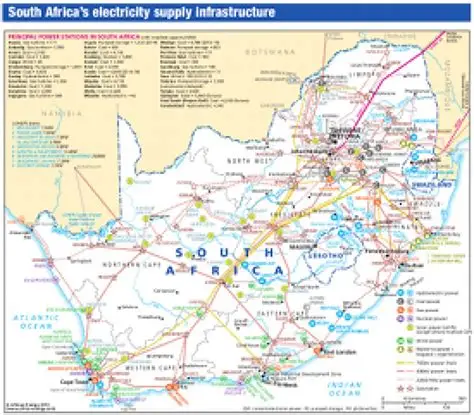
“South Africa has signed a $122 billion partnership with China to expand its power grid by 105 GW and build 14,500 km of new transmission lines, marking one of the largest energy investments in the country’s history. The deal will localize manufacturing, create thousands of jobs, and strengthen energy security by reducing reliance on diesel and aging coal plants.”
For over a decade, South Africa has faced rolling blackouts, an aging coal fleet, and financial strain on Eskom due to reliance on costly diesel generation. These challenges have undermined investor confidence and slowed economic growth.
Details of the Partnership
- Investment Size: $122 billion over the next decade.
- Capacity Expansion: 105 GW of new generation capacity, nearly doubling current installed capacity.
- Transmission Infrastructure: 14,500 km of new transmission lines by 2039.
- Localization: Manufacturing of transformers, turbines, cables, batteries, and solar equipment within South Africa.
- Technology Transfer: Training programs for South African engineers and technicians.
- Joint Ventures: Partnerships between Chinese and South African firms to strengthen domestic supply chains.
Strategic Importance
- Energy Security: Diversifies supply, reduces reliance on diesel, and stabilizes the grid.
- Economic Growth: Reliable electricity will boost mining, manufacturing, and agriculture.
- Job Creation: Thousands of skilled jobs in manufacturing and infrastructure.
- Financial Stability: Lower diesel imports ease Eskom’s financial burden.
Regional & Continental Impact
The Africa Energy Indaba highlighted that transmission and distribution (T&D) infrastructure is now a defining priority for Africa’s energy transition. South Africa’s program sets a precedent for other African nations, emphasizing grid modernization, smart grids, and cross-border interconnectors.
Risks & Challenges
- Debt Concerns: Large-scale borrowing could strain national finances.
- Implementation Timeline: 105 GW and 14,500 km of lines require decades of sustained effort.
- Geopolitical Dependence: Heavy reliance on Chinese investment may raise sovereignty questions.
- Weather Vulnerability: Recent cold fronts have shown how fragile networks remain under stress.
Expert Commentary
Liz Hart, Managing Director of the Africa Energy Indaba, noted: “The scale of South Africa’s planned investment demonstrates that transmission and distribution infrastructure has become one of the defining priorities for Africa’s energy transition.”



