




“South Africa is increasingly placing space technology within its wider industrial policy, with the government linking satellite manufacturing, aerospace engineering, technological sovereignty, national security and economic development. Minister Parks Tau said at AAD 2026 that government-backed industrial programmes have supported emerging aerospace businesses while South Africa’s “New Space” companies have placed locally developed satellite technology into orbit.”
South Africa’s space ambitions are increasingly being tied to national industrial policy, technological sovereignty and the government’s effort to expand domestic high-technology manufacturing. The latest significant political development identified in current coverage is a 17 September 2026 address by Trade, Industry and Competition Minister Parks Tau at the Africa Aerospace and Defence exhibition, where he linked government support for aerospace companies with South Africa’s wider strategy for building local capability, exports and sovereign technological capacity.
Tau said the Aerospace Industry Support Initiative (AISI), established two decades ago, has grown from a small programme into a roughly R50 million-a-year intervention. According to the minister, AISI has supported 142 small and medium enterprises during the past decade, helped create or sustain more than 1,236 jobs, enabled 148 technologies and products, and assisted companies in obtaining 49 international certifications and standards. He said the programme’s interventions generated about R381 million in local industrial output and more than R332 million in direct exports.
The political significance of the announcement lies in the way space is being treated not simply as a scientific field, but as part of industrial development. Government policy is increasingly connecting satellite technology, advanced manufacturing, aerospace engineering, defence technologies and skills development. That approach places space within a broader argument about whether South Africa can develop and retain strategic capabilities locally rather than relying heavily on imported technologies.
Tau highlighted several companies as examples of this industrial approach. Among them was LambdaG, which developed a space-qualified Global Navigation Satellite Systems antenna for low-Earth-orbit satellites. He also pointed to Simera Sense, NewSpace Systems and Dragonfly Aerospace as part of South Africa’s “New Space” cluster, saying their work has helped put South African-built satellite technology into orbit. These examples demonstrate how government-backed industrial programmes can intersect with commercial space manufacturing and international markets.
The government’s role is also regulatory. South Africa’s space activities operate within national legislation and international obligations governing the peaceful and responsible use of outer space. Tau said members of the South African Council for Space Affairs had been appointed to help maintain a regulatory environment for space activities. The council is the statutory authority established under the Space Affairs Act, giving regulation a central place in the country’s space policy architecture.
The appointment of the council is important because South Africa’s space sector involves activities that extend beyond research laboratories. Satellite manufacturing, Earth observation, communications, launch-related services, space science and other activities can involve sensitive technologies, international partnerships and commercial interests. A functioning regulatory system therefore has implications for investment, safety, international cooperation and national interests.
Another major policy issue is the relationship between public investment and private-sector growth. The government’s argument is that programmes such as AISI can help companies overcome the high costs and technical barriers associated with aerospace and space industries. These sectors often require advanced testing, certification, specialised equipment, research partnerships and highly trained personnel before a company can compete internationally.
The minister also connected aerospace and space policy with national sovereignty. In his address, he argued that the ability to design, build and maintain strategic technologies domestically matters for national security and economic resilience. This argument is particularly relevant to satellites because space-based systems can support communications, environmental monitoring, agriculture, disaster management, navigation, infrastructure planning and security-related functions.
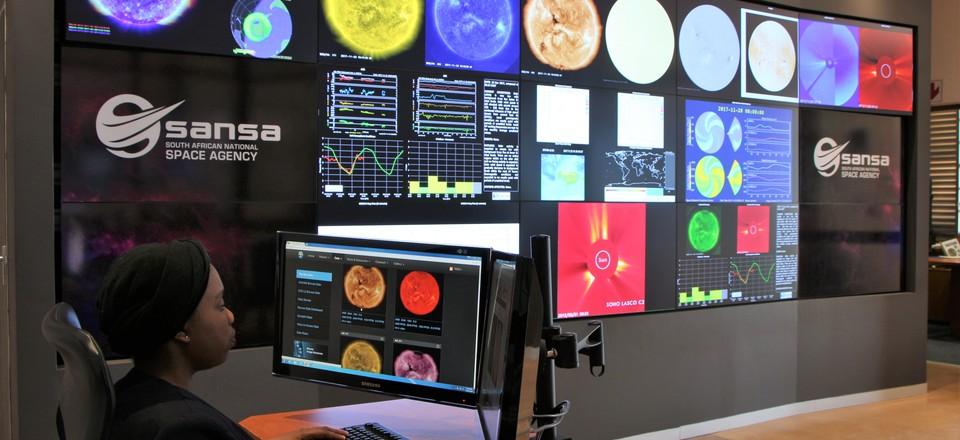
South Africa’s National Space Agency, SANSA, already provides capabilities in Earth observation, space science, space operations and space engineering. Its own description of its work says satellite and space information supports policy and decision-making, resource and disaster management, food security and national security. This illustrates why space policy increasingly intersects with ordinary government responsibilities rather than remaining a specialised scientific concern for South African citizens.
One example is satellite imagery procurement. Earlier in 2026, SANSA said the government was moving toward a coordinated national approach to satellite imagery procurement. The initiative was presented as a way to reduce costs, strengthen data sovereignty and improve evidence-based planning across the public sector. The policy question is therefore not only how South Africa builds satellites, but also how government institutions use space-derived information and whether public spending is coordinated effectively.
South Africa is also investing in longer-term infrastructure. SANSA and the Laingsburg Municipality reaffirmed a partnership around the development of a Deep Space Ground Station at Matjiesfontein. SANSA said the project is funded by the Department of Science, Technology and Innovation and is intended to strengthen South Africa’s deep-space communications capabilities while creating scientific, economic and educational opportunities in the surrounding area.
The political dimension of such infrastructure is significant because major scientific facilities require public funding, institutional coordination and long-term policy commitments. They can also influence regional development by creating demand for construction, engineering, technical services, education and research. The challenge for government is to ensure that these investments generate measurable national and local benefits over time.
The broader aerospace strategy also places emphasis on small and emerging enterprises. Tau said AISI is intended to help companies overcome barriers to entry and develop globally competitive capabilities. He also stressed transformation, including requirements connected to Black Economic Empowerment for supported firms. This makes aerospace and space policy part of the wider debate about ownership, participation, industrial concentration and access to advanced technology.
The government’s approach is not limited to civilian space applications. Aerospace, defence and space technologies increasingly overlap through areas such as autonomous systems, advanced materials, avionics, satellite communications, navigation and cybersecurity. That overlap creates opportunities for dual-use technologies, but it also means policymakers must balance commercial development with security, export controls and international obligations.
The Africa Aerospace and Defence exhibition provided a political platform for these issues. The South African government described AAD 2026 as a major opportunity for technological innovation, international collaboration, defence diplomacy, trade and investment. Its significance for space lies partly in the industrial ecosystem around aerospace, where companies, researchers, government departments and international partners can interact.
South Africa’s space sector therefore sits at the intersection of several policy priorities: industrialisation, scientific research, digital and data sovereignty, national security, skills development, international cooperation and economic diversification. Government statements suggest that policymakers want these areas to reinforce one another rather than operate as separate programmes.
At the same time, official claims about jobs, exports and industrial output should be understood as government-reported programme results rather than independent evaluations. Measuring the long-term effectiveness of industrial support requires examining whether supported companies remain competitive, generate sustainable employment, attract private investment and develop products capable of succeeding without continuing public assistance.
For South Africa, the next stage of space policy will therefore involve more than launching or manufacturing satellites. It will involve deciding how public institutions coordinate procurement, how regulation supports responsible private investment, how universities and industry develop skills, and how national infrastructure is connected to practical economic and public-service needs.
The latest political discussion shows that space has become part of a much larger national development conversation. South Africa is seeking to use aerospace and space technologies to strengthen domestic industrial capability while participating in global markets. Whether those ambitions translate into durable economic and technological gains will depend on implementation, investment, skills, regulation and sustained cooperation among government, industry, universities and research institutions.



